Showing posts with label Butterflies. Show all posts

Sunday, February 9, 2014

Birdwing Butterflies prints now available on Deviantart!

Hey ya'll

The prints in my birdwing butterfly set have been really popular on deviantart as postcards or prints. Birdwing butterflies are probably one of my all time favorite of butterflies. Not only do their large size make them a breathtaking sight in any setting - both captive and wild - but their iridescent wings and uniqueness to the Southeast Asian region also give them an exotic touch that is quite unique to the species. 

The Southern Tailed Birdwing (Ornithoptera meridionalis) is the smallest of all the birdwing butterflies. Like the Queen Alexandra's birdwing butterfly (which is the largest butterfly in the world) the species was discovered by Walter Rothschild in Milne Bay Province, Papua New Guinea. The species is fairly widespread and may be found in several localities in southeast Papua New Guinea and the southern coast of Irian Jaya. Along with the Paradise birdwing (Ornithoptera paradisea) it is the only butterfly of the birdwing family whose wings are tailed.  Like several other species of birdwing butterflies, it is classified as "endangered" in the IUCN red list due to habitat loss in various parts of Papua new Guinea.  

Conservation initiatives that engage local communities have proven to be fairly successful and there are to date several villages in Papua New Guinea which farm the butterfly for conservation and commercial purposes. The specimens are incredibly valuable and may fetch prices as high as US$1000 per pair. Despite its desirability, collecting of the butterfly has little to negligible effect on its population size provided the original habitats are left undisturbed. The butterflies are remarkable in that they have an extremely small amount of wing area in relative to its large and bulky body. Male butterflies have hind wings that are severely reduced, tapering at the end into a pair of filamentous tails which are easily broken. The males of the species are thus rather clumsy and weak fliers and spend most of their day resting on the canopy layer of primary rainforests. The larva of the butterfly feed on the plants of the genus pararistolochia and incorporate its toxins into its defense system during its development and adult life.  

Ornithoptera priamus, or the common green birdwing, is a very widespread species of birdwing butterfly that is found in New Guinea, Moluccas, the Bismarck Archipelago, the Solomon Islands, and Northeast Australia.  Because of its sizeable range, the butterfly is extremely variable and is believed to have evolved multiple subspecies each exhibiting different markings, patterns, coloration, and forms. According to some experts, there are as many as 99 subspecies of Ornithoptera priamus butterflies although others would contend that some of these subspecies are to be treated as independent species altogether.  Most of the subspecies of Ornithoptera priamus feature brown and cream-patterned females and iridescent green males, although several subspecies such as Ornithoptera priamus urvilleanus, and Ornithoptera priamus miokensis have blue wings. Despite being an overall widespread and established species, some subspecies of the butterfly which are endemic to certain parts of the world are threatened by habitat destruction: primarily the clearing of primary forests (which the butterfly needs for its survival) for the palm oil trade. Many other subspecies, such as Ornithoptera aesacus may be seriously endangered in the wild but otherwise fairly commonly bred in captivity. 

Fun fact: the butterfly is named after Priam, the King of Troy during the Trojan War. 


IF you would like to see similar prints or show your support by purchasing them, do check out my profile on deviantart : http://cyrenization.deviantart.com

Thursday, February 6, 2014

Rajah Brooke Birdwing Plate

Natural History Style plate of a Male Rajah Brooke's Birdwing (Trogonoptera brookiana albescens) an artistic side project and work in progress of the insect life of Ulu Geroh
source: http://cyrenization.deviantart.com

Rajah Brooke's Birdwing Puddling Site


Hey ya'll
First of all, allow me to apologize for the lack of updates. It amuses me somewhat to see that, despite my absence, the blog has continued to receive a fair trickle of visitors! Anyway I just got back from my field work at Ulu Geroh about slightly under a week ago. I am living there with the Semai community, an indigenous group of people of Peninsular Malaysia, as part of the field work process for my PhD dissertation.  Among other amazing natural wonders, such as several species of Rafflesia which flower there, there rainforests surrounding the Ulu Geroh settlement is renowned for having a high diversity of insect species, most notably, butterflies. It is also one of the few remaining sites in Malaysia where the Rajah Brooke's Birdwing butterfly gather in large numbers on the banks of river to imbibe upon the nutrient rich salts that are present in the mud. I shared the video of one such puddling site sometime earlier this week and so it only natural that it would soon be followed by the photographs. Check it out. 

Some of these butterflies grew so "drunk" on salts that they abandoned much of their usual, jittery dispositions and could be coaxed to climb upon my outstretched palm.

Butterfly roosting on the palm of my hand.


Butterflies precariously perched on a layer of algae that has grown over some of the more stagnant puddling sites. Some of these algae platforms "give way" when there are too many butterflies on top of them and the "Drunker" are not always able to react fast enough and  fall into the water.

A first, butterflies puddling on grass!!! Actually this shot was taken very close to a natural hot springs so it is possible that the soil was equally rich in salts and minerals. 

Thursday, December 26, 2013

Queen Alexandra's Birdwing Butterfly


The Queen Alexandra's Birdwing Butterfly (Ornithoptera alexandrae) is the largest butterfly in the world. It is also one of the few species of butterflies that are truly protected by law. The butterfly, which was named in 1907 in honor of Queen Alexandra of Denmark by Walter Rothschild, measures a whopping 13 inches from one wing to the other and can only be found in a very restricted eco-zone in the coastal rainforests of Oro Province, Papua New Guinea. The butterfly is listed on the Appendix 1 of CITES, which makes all trade of the insect illegal. Specimens of the Queen Alexandra's Birdwing can fetch up to 10,000 US dollars on the black market. Despite this, the main threat to the butterfly's population is arguably not collectors, but the felling of old growth rainforest for plantation land for the palm oil trade which is slowly cutting into the meager 100 square kilometers of rainforest in which the butterfly is exclusively found. The population of Queen Alexandra's Birdwing Butterflies also faced a significant blow during the eruption of Mount Lamington in the 1950s, which destroyed a significant portion of the species' former habitat. 

Like all birdwing butterflies, the Queen Alexandra's Birdwing displays extreme sexual dimorphism. The female, which can reach a wingspan of 13 inches, body length of 3 inches and a body mass of 12 grams (all enormous measurements for a butterfly) is predominantly brown in color with cream or white markings arranged in rows on its wings while the much smaller male displays wings that are an iridescent blue-green in color and have a wingspan of approximately 9 inches or smaller. Male butterflies sometimes develop gold spots on their hind wings and this "atavus" form is often considered to be one of the most spectacular of all birdwing butterflies. 

Female butterflies lay approximately 27 eggs throughout their lifetime on plants of the genus pararistolochia. The larvae imbibe aristolochic acids from the plant's leaves which in turn functions as a potent vertebrate poison that defends them from many predators. The life cycle from egg to pupa takes about 6 weeks to complete. Pupation generally lasts for a month, and the butterflies emerge from their chrysalis only in the early mornings when the sun is not yet at its peak and the air is humid because the enormous wings may dry out before they have fully expanded if the humidity drops. and adult butterflies can live for an average of three to four months. Because of their toxicity and large size they have very few predators aside from large Orb weaving spiders (Nephila spp.) and some birds which have developed methods for eating poisonous butterflies. Adult butterflies are strong fliers and rarely stray from the canopy making them rather difficult to observe. In fact, the first butterfly to be discovered was actually taken with the aid of a small shotgun by Albert Stewart Meek (a collector under the employment of Rothschild) but subsequent specimens were obtained from captive bred stock after Meek discovered the early stages for the species. 

If you like what you see, you can check out more of my artwork, updated regularly at:
Artist: http://cyrenization.deviantart.com/

Tuesday, June 11, 2013

Reviews of a Poke'mon Entomologist: Vivillon


Hey ya'll 

So Nintendo just announced a couple of new things recently in conjunction with the Poke'mon franchise, and in addition to the news of a new type being introduced (it is Fairy, btw), two new species of Poke'mon have alos been added to the mix one of which is the pretty butterfly Poke'mon, Vivillon. Vivillon is described on the official Poke'mon website as a beautiful butterfly Poke'mon that can perform status attacks by dislodging the scales on its wings, or create strong gusts of wind. The description of it is fairly typical, as far as bug Poke'mon go and Vivillon is pretty standard in this regard. In terms of its name I can only guess that it combines the words "Vivid" and "Papillon" (which is French, for butterfly) or "Papillio" (which is the latin name for swallowtail butterflies) literally meaning a brightly colored butterfly Poke'mon. It recycles many traits that are pretty standard of previous butterfly-moth Poke'mon and seems to particularly embody physical aspects of generation 1's Butterfree and generation 3's Beautifly. Vivillon's type is purpoted to be Bug and Flying which, again is not particularly remarkable as many Bug Poke'mon share that typical combination. Part of me is hoping, however, that Nintendo will do a surprise switcheroo at the end and maybe give it a more unique type casting, perhaps Bug and Psychic, or maybe even Bug and Fairy. Having said that I am quite psyched by the appearance of this poke'mon as it marks the return of the butterfly-moth that was introduced in almost every installment of the poke'mon game save the latest Black-White edition.  Am definitely going to give Pokemon X and Y a go when it comes out later in the year, even if it means having to buy a whole new console for it. Which brings me to the question: anyone have second hand Nintendo 3DS for sale? 


ps. if you haven't yet noticed it, check out the animated Vivillon that now inhabits my side bar! Pretty nifty huh? 

Cheers, Cyren

Monday, April 29, 2013

Love Insects, Love Life

Hey ya'll

today's post will be more of a rant and a personal call for action more than anything else. I realized if I don't speak up for the insects, no one will. Are you an insect lover yourself? If the answer is yes, then maybe it is time for us to raise our voices a little higher. These small, often overlooked, creatures form the basic building blocks of our existence! Despite all the talk of conservation and animal rights going on, not many people stop to consider the plight faced by many insects as a result of climate change, habitat loss, and general environmental degradation. It is time to understand that these living things are not "just bugs". I really hate to put it in such words, but if a species of monkey goes extinct, life would probably still manage to go on as it is... but if an entire species of bee, or wasp goes extinct, you can be sure that life would not longer be the same as we know it! The majority of our world's pollination activities are attributed to insects! In fact, many higher order of plants are pollinated by insects! Many of these plants are also species specific pollinators which means they are pollinated only by specific types of insects. It's a very simple equation, really: No pollination = no propagation of plant species = no more fruits and flowers! It is time to understand that these animals are not "just bugs". A world without insects is a world without plants and a world without life!

But I didn't just write here to rant. We can prevent this! The change begins with you! How? Observe these simple steps. 
  1. Do some research! Be observant of the world around you! What kinds of insects come and go in your neighborhood. What sorts of plants do they feed on? What can you learn about them? 
  2. Satellite Gardens. Cordon of small parts of your garden as an allocated space for insects! Plant the host plants of insect larvae (if you can identify them), and grow all sorts of flowering plants that wasps, butterflies, and bees can feed on! This way you will ensure that the insects always have a place to return to and a source upon which they can rely for food! In our rapidly developing world, where vast plains of vegetation are constantly being cleared in the name of progress, these small sanctuaries may be all that's left for the insects at the end of the day. 
  3. SPREAD the word! The more satellite gardens we provide, the more we can ensure the insect's survival! If you are a student, speak to your school administrator about this. Speak to your friends, your neighbors, anyone who will listen. Together, we can make a difference. 

Love all animals, love insects, love life. 

Autumn leaf butterfly (doleschallia bisaltide) eclosing

Cheers,
Cyren.

Sunday, April 14, 2013

Butterfly display case


Hey ya'll 

Just a quick updates before Monday. Display cases an be so difficult and near impossible to locate in Malaysia and so,  I finally decided to invest some time and money into constructing my very own butterfly and moth display case! It wasn't easy, and it cost me a lot of painful fingers, and quite a bit of money... but I daresay the result is well worth it! Anyway I have more buggy delights coming up in the next few weeks or so, so please stay tuned. Somewhat inspired by the success of this display, I'm thinking of constructing another one detailing the life history of various Malaysian cicadas! Stay tuned. 


Cheers,
Cyren.

Thursday, April 11, 2013

Butterfly Spreading for Dum- Beginners!

Hey ya'll

The collecting of butterflies to be preserved as specimens has always been a very touch subject, even among lepidopterists! There are those who study butterflies who limit their observations only to live insects seen in the wild, and those who practice the added dimension of observing dead specimens in the lab. From a scientific point of view, the advantages that come from having preserved specimens far outweigh any possible moral outrage that might result from such a course of action. Dead butterflies, for one, do not flutter about so (thus damaging themselves!) meaning that they can be observed and categorized with greater depth and precision, and some butterflies are even difficult and near impossible to distinguish unless looked at under a microscope! Many skipper butterflies from the family hesperiidae are like this. Even for the average Joe collector, butterfly collecting can be a very insightful and rewarding experience! It is true that to obtain perfect specimens, butterflies do get killed in the process. But if it is any small consolation to those of you who might be sufficiently morally outraged by now: 

  1. No butterflies have ever been hunted to the brink of extinction! (You can blame deforestation and general environmental degradation for that!) 
  2. Butterflies are primarily instinctual creatures, they do not perceive emotions like pain or fear the way humans do
  3. Most collectors, experienced ones at least ,are very "humane" in their methods and either use killing jars or the refrigerator method to put the insects to "sleep" where they eventually slip away into death. 
For those of you who might be interested in collecting butterflies, however, spreading the insects can be a fairly daunting thought! Butterflies, unlike other flying insects like dragonflies, cicadas, or even grasshoppers, have very thin and fragile wings! Furthermore, the colors of butterfly wings are made out of millions upon millions of overlapping scales which rub off easily causing the butterfly to lose much of its color and grandeur! With all these difficulties in mind, I have thus decided to put together a step-by-step guide for the beginner on how to properly spread and preserve butterflies. 

Step 1:
First things first, you are going to need to pin your butterfly! It is often ideal to use entomological pins for this, but I understand that they are not always so readily accessible. I use tailor marking pins (the kind that is used to make marks on tailoring dummies) and have no problem with them except for some of the smaller specimens for which the pin may be a little too big. Anyway pins often come in various sizes anyway so you can always just adjust the size of the pins that you pick up from the store. Now, you want to put the pin as close to the center of the abdomen as possible and at a vertical angle. This is, obviously for aesthetic purposes, but also because it is arguably the strongest spot in the butterfly's body. The butterfly's body when straightened should form a 90 degree angle with the pin. Don't worry about it if you get this wrong on your first try and  I would advice removing and reinserting the pin too many times. Remember, each time you do that, the pin will leave a hole in the insect's body... too many little holes may eventually lead into some very serious, and irreversible damage to your specimen! 

Step 2:

Prepare a spreading board for the butterfly by placing two smaller boards of styrofoam on top of a larger board that will form the base. There should be a gap or a wedge between both styrofoam boards and this is where the butterfly's body will go. Make sure the boards are securely pinned down as you don't want them to shift about while the butterfly is being spread as this can cause damage to the wings, or cause unwanted changes in alignment. Once you've prepared the board sufficiently, place the butterfly's body inside the wedge, making sure the pin attached to it is securely stuck onto the main base. Make any necessary adjustments to ensure that the wings rest nicely and evenly on the boards on either side. If the butterfly's body is not secure within the groove (i.e it still moves about) you may hold it down by placing two pins on either side of it. Stick the pins on either side of the butterfly where the lower joint of the hindwing meets its body. This is the strongest spot and will prevent it from moving while you work on the wings. 

Step 3: 

The most crucial part of the process: spreading the butterfly's wings! Now as previously mentioned, butterfly wings are VERY fragile so you have to take special care not to damage them in the process. Different lepidopterists will have different methods of doing this, each involving different tools but I'm just going to tell you of the one I like the best. Using the flat end of the pin (that's the end OPPOSITE of the sharp bit), gently coax the wings into the desired position. Do this by slowly slipping the pin head underneath the upper edge of the forewing and gently tugging on the primary wing vein close to the insect's body which is the strongest structure of the wing and the least likely to tear. You may have to use your fingers, or a pair of forceps (depending on how confident you are about your control) to edge the wing into position but the same rule applies. Always work with the primary wing veins. When you have got the forewing in the desired position, gently lay down a piece of tracing paper (I use it as it is the most gentle) and pin it down around the edges of the wing. Depending on the species and the strength of the wings, you may have to use more than one or two pins. For the hindwing, slip the pin head on the lower edge of the wing, close to where the wing joint meets the body and gently push until the upper border of the hindwing rests somewhat covered by the fore wing. The goal is to ensure that the border of hindwing-forewing is set at a 90 degree angle from the butterfly's body. 

Step 4: 

Simple enough, repeat the above process for the other side. When you are done, you can place a ruler from one tip of the wing to another to see if you've got a butterfly that is "straightly" and "evenly" spread. Don't worry too much if you do not achieve this at your first try. I've got tons of botched up specimens this way and I can only say that practice makes perfect! Now is the time for the final touch ups. Using the pin heads, gently coax the antenna into desired position. You can place several more pins to keep it there, or use a separate strip of tracing paper. If the butterfly's body had contorted or moved slightly out of position during the spreading process, you may now use a pin to gently push it into position and leave the pin there until the specimen re-dries where it will stay in said position. To preserve specimens and prevent fungal growth or attack by ants/pests, I spray all butterflies with water-based insect poison. Don't be alarmed if you notice discoloration as the wings will return to normal once they have dried up.

Anyway I hope this guide has been sufficiently helpful with your butterfly collecting endeavors! I understand that other's may have different methods from mine and I daresay it's pretty much a case of whatever works best for the individual. I learnt most of what I know from more experienced friends and now really just wish t to pass this knowledge down. Just remember, practice makes perfect so do start with common, more readily accessible specimens as opposed to jumping straight into the swing of things with, say, a birdwing! 

Cheers,
Cyren. 

Saturday, April 6, 2013

Caterpillar Couture: Fashion and Survival in the Insect World


Hey ya'll 

Of all the wonderful butterflies and moths that I have seen in my short (but somewhat eventful) life, the only other insect that can perhaps compare with these winged beauties in terms of sheer wonder and elaboration in evolutionary design, are perhaps their very own offspring: the caterpillars. Now it is quite understandable that most people would find this statement perplexing as it is true that the general rule is for caterpillars to remain as unnoticeable as possible! A caterpillar, generally speaking, is literally nothing more than a skin filled with hydro-static hemolymph and developing organs! Consequently, it is really quite fragile and vulnerable to attack! Staying hidden, or properly camouflaged with one's surroundings, is therefore a pretty necessary strategy that most caterpillars have to learn, or die trying! Some caterpillars, however, have absolutely no need to hide! And while a caterpillar is most certainly not the most aggressive of animals, many of them have developed chemicals means through which they may defend themselves from predators and they often do this in very fashionably beautiful and amusing ways! 

The caterpillar of the puss moth (Cerura vinula) is a fairly unremarkable caterpillar for most of the time. That is, until you piss it off! It really is about as aggressive as a caterpillar can be. When threatened, the caterpillar will rear up on its hind legs to display a striking looking "face" that might startle predators into backing off. To enhance the illusion, the caterpillar also possesses a pair of tentacles or tendrils at the back of its body that it can wave about furiously and menacingly to ward off potential predators. If all else fails, though, the caterpillar will employ its final method of defense: a concentrated spray of formic acid to the face! Formic acid is a type of poison that is typically produced by ants, wasps, and bees, and the caterpillar of the puss moth is quite unique in its ability to do so. 


Not all caterpillars have to be aggressive to ward off predators though, and in fact, aside from the larvae of the Puss moth, few actually are! Most caterpillars employ a more passive aggressive means of defense typically meaning they will remain passive even when a predator is being aggressive. But who needs to be aggressive really, when your entire body is covered in a cornucopia of envenomed spikes that will make even Lady Gaga turn green with envy! Slug moth caterpillars (Limacodidae) are perhaps one of the most interesting caterpillars in the lepidopteran world! The variation in coloring and form is only as diverse as the various means through which they defend themselves. Many though, are covered in some form of urticaria. This means that brushing against one of these caterpillars can be potentially discomforting or even painful! Caterpillars of the tussock moth also advertise themselves brazenly with tufts of fur and setea that look more at place in a Mardi Gras parade than on an insect. The caterpillar, however (surprisingly enough) is not poisonous per-say. Rather these setea break off very easily and may cause a rash if embedded in the mucousa membranes of animals. This sort of defense is believed to target the mouths and eyes of predators as the thickness of the fur, and the extreme ease through which they break off is often enough to protect the insect from the predator's initial strike.  


As "prevention is always better than aggression" seems to be the prevailing policy when it concerns most insects, many of these caterpillars are also brightly colored so that they will not easily be missed such as the caterpillar of the lacewing butterflies  (Cethosia sp.) While one might think that this would attract predators, the bright colourations are typical of aposematic warnings in the animal Kingdom. Basically they advertise: "Attack me, and you might just regret it!" Many animals learn to avoid caterpillars with such coloring and are therefore less likely to attack them even by accident as the bright colors force the predators to take special attention to their presence.


Because the methods of aposematic coloration are so good at warding off predators, this has led to the emergence of several "copy cats" in the animal kingdom. After all, why waste time and energy synthesizing poisons from the plants that you eat when you can just "look" poisonous and be done with it. The hickory horned devil (Citheronia regalis) is a perfect example of this. These caterpillars look extremely BADASS! In fact in terms of appearances, these caterpillars are like the siege tanks of the insect kingdom. The caterpillar is one of the largest in North America and can grow to over 5 inches in length and are crowned with brightly colored, cruel looking spines along their heads and down their backs. The caterpillars themselves, however, are quite harmless and it would seem that evolution is finally catching up to them! Despite their fearsome appearances, more and more of these caterpillars are consumed by birds every year and the numbers are increasing! In fact in some areas they have even been recorded to have become "local bird favorites". Better keep up with the evolution, guys! 

However when all is said and done, perhaps the best defense IS still a best defense and why expend any energy at all synthesizing poisons, drawing attention to oneself, or pretending to be something one is not when one can simply just blend into one's surroundings? Some caterpillars, however, take "blending in" to new extremes. The caterpillars of the jewel moths (Acraga sp.) are named not for their adult form (which resemble furry dog-moth hybrids) but rather, their larval stages which literally resemble translucent/transparent mounds of gelatinous flesh! These caterpillars theoretically remain entirely invisible by refracting and reflecting the colors and lights from their surroundings making them, quite literally, mother nature's cloaking device! Perhaps the "prettiest" way of remaining unseen. 

Cheers,
Cyren

Wednesday, April 3, 2013

Newly Discovered Butterfly Species lives up to its Name.

Hey ya'll

Today is supposed to be my day off! The university actually closed for the Easter Break starting Monday but I have been going back into the office like clockwork to get some work done. Try as I might, though, this hasn't been a very productive week  and I'll be lucky if I finish 7 readings by next Monday (which would make a minimum of one text a day). Meanwhile, I was trolling the virtual insecto-sphere when I came across an interesting little picture of a very beautiful butterfly.

This butterfly is called the Resplendant forester (bebearia sp.) and was apparently discovered quite recently during 2012 in Africa. Isn't it a vision? In my opinion it is almost beautiful enough to rival the Madagascan sunset moth (Chrysiridia ripheus). The bebearia are a group of butterflies that fall under the genus of brush-footed butterflies (Nymphalidae) which generally possess brightly colored patterns on the dorsal surfaces of their wings, with a subdued more cryptic coloration on its ventral surfaces for purposes of camouflage when the butterfly is not in motion or at rest. As per the name of its genus, the butterflies have severely reduce forelegs that resemble miniature paint brushes giving them the appearance of possessing no more than four legs. Other notable bebearia sp. are the Shiny green forester (Bebearia barce), and Hewitson's forester (Bebearia tentyris). I wonder when it will be my turn to discover a previously undescribed/unheard of species. Hmmm. I guess until then all I can do is focus on the project at hand.

Happy Thursday everyone!
Cyren

Artist, Lepidopterist, Woman: Celebrating the Life and Work Maria Sibylla Merian

Hey ya'll

When celebrating the contributions of some of the great women in history, it is often easy to overlook (among all the humanitarians among great women) the women who were involved in the documentation of natural history such as Maria Sibylla Merian. Maria, a naturalist and scientific illustrator, was not only one of the first woman to be actively involved in the field of natural history (then considered a primarily/if not exclusively male domain) but also the first to carefully observe and document the life cycle of insects thus making her one of the most significant contributors to the field of entomology. It is therefore of much appreciation that Google chose to feature, and celebrate her life yesterday by changing their header in commemoration of her 366th birthday. 

Early Life

Maria Sibylla Merian circa 1700
For much of her early life, Maria Sibylla Merian exhibited a fascination for insects! Having been encouraged to take up drawing and painting by her stepfather, Merian eventually began to utilize her talent to document and illustrate the various creepy crawlies that she encountered. Of particular interest to her, not surprisingly, was the metamorphosis of caterpillars into butterflies and moths. 

I spent my time investigating insects. At the beginning, I started with silk worms in my home town of Frankfurt. I realized that other caterpillars produced beautiful butterflies or moths, and that silkworms did the same. This led me to collect all the caterpillars I could find in order to see how they changed. 

In Holland, with much astonishment what beautiful animals came from the East and West Indies. I was blessed with having been able to look at both the expensive collection of Doctor Nicolaas Witsen, mayor of Amsterdam and director of the East Indies Society, and that of Mr. Jonas Witsen, secretary of Amsterdam. Moreover I also saw the collections of Mr Fredericus Ruysch, doctor of medicine and professor of anatomy and botany, Mr. Livinnus Vincent, and many other people. In these collections I had found innumerable other insects, but finally if here their origin and reproduction is unknown, it begs the question as to how they transform, starting from caterpillars and chrysalises and so on. 

(Foreword from Metamorphosis insectorum Surinamensium)

Contributions to Science 

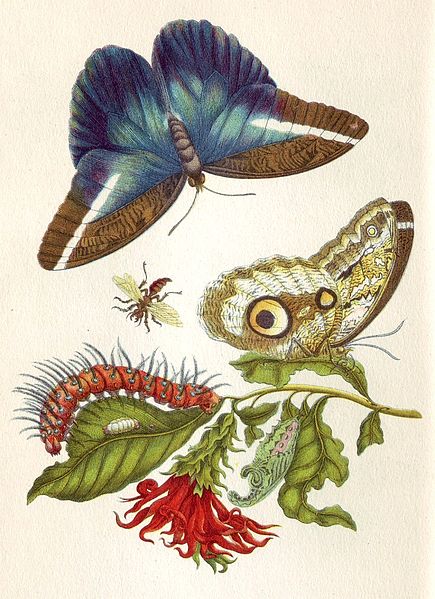
a plate from Metamorphosis insectorum
Surinamensium
As evinced from her foreword, it would therefore seem that though an interest and study in natural history was quite dispersed at the time, not many people displayed an explicit interest in the origin and life cycles of many of their insect specimens. This in turn might be retrospectively attributed to the common belief in those times that insects were "Beasts of the Devil" and thus, spontaneously generated from the ground. As an amateur lepidopterist, Merian's work with butterflies and moths, and a grand total of 186 insect species might therefore be said to be pioneering in that it was one of, if not THE first work to document insect lifestyle and evolution with such attention to detail.


Plate from Metamorphosis Insectorum
Surinamensium
Conversely though it can be argued that there were some local scholars of the time who had already been aware of the life cycles of butterflies or moths, it could also similarly be opined that not many of them truly understood this process. It was Merian's work, for example, that first illustrated the fact that caterpillars were often dependent on specific host plants and that eggs were often laid close to, or on these plants for ease of the developing larvae.  In addition to her work with insects, Merian successfully discovered and described a whole range of animals and plants in the interior of Surinam. Her classification for butterflies and moths and her use of Native American names to refer to the various species of plants she encountered is still relevant in the field of science today. In fact, the infamous "bird eating" spiders of South American probably owe their reputation and name to a drawing made by Merian depicting such a spider devouring a small bird.

A Curious Woman in a Man's World
a plate taken from Metamorphosis insectorum
Surinamensium

Although much of Merian's work, such as Metamorphosis insectorum Surinamensium, and The Caterpillar's Marvelous Transformation and Strange Floral Food were very popular in high society as a result of its publication in the vernacular, much of Merian's work was continuously largely ignored by many within the scientific community at a time when the official language of science was considered to be latin. Similarly, many male scientists, who had never set foot in Suriname themselves, claimed her to be a fraud. Naturalists like the Reverand Lansdown Guilding dismissed her description of army ants and bird eating spiders stating that "Madame Merian has told a willfull falsehood." Such criticisms and accusations would eventually take a toll on her reputation as a careful observer of nature.

Furthermore, while scientific surveys of natural wildlife were not exactly uncommon at the time, they were usually carried out by men who were already being sent to colonies to live, or work, there. Consequently, Merian's decision to self fund her own expedition in pursuit of her interest raised many eyebrows especially over the fact that she was a woman. Despite the doubt of others, Merian's perseverence and tenacity paid off and in 1699, the city of Amsterdam sponsored her petition to travel to Suriname in South America. During stay, Merian traveled between the various colonies, documenting any plant or insect life she came upon there. "In the era of investigation dominate by the collection and classification of organisms, Merian's organic apporach to the study of natural history was unusual and was not always understood by her fellow scholars," (Etheridge, 2010: 19). Incidentally, her observations on the metamorphosis of frogs was the first to ever be recorded with such accuracy. She also took note of the natives and black slaves that were then employed by Dutch planters and is often quoted to be quite critical of the treatment of the Dutch masters over these people.

Late Life

Plate from Metamorphosis Insectorum
Surinamensium
Barely 2 years into her expedition, however, Maria contracted a case of malaria and was forced to return prematurely to the Netherlands. There she spent her life selling the specimens she had collected and publishing engravings of the plant and animal life she had encountered in Surinam. In 1705, she published the world famous Metamorphosis Insectorum Surninamensium. In 1715 at age 67, Merian suffered from a stroke which greatly affected her ability to work. Not much is known about her later life from this point on except that she is listed in a registry as being a pauper. Merian died, two years later in Amsterdam. Her work was only rediscovered, recognized and reprinted in the last quarter of the 20th century. 


Merian and her work is continued to be recognized in this day and age, and her likeness has graced both the likes of stamps and currency but it is arguable that not many people have actually come to recognize and appreciate her contributions to the field of science with specificity to the field of entomology. As a feminist, and an amateur lepidopterist myself, I suppose you could say that I have come to deeply admire Merian and have a strong sense of appreciation for her work (I even have a few of her prints that I intend to frame and display alongside my butterfly and moth collection someday). Perhaps, when I begin conducting my own field studies in the Northern part of Malaysia, I can undertake a similar personal project of my own! It is therefore with much praise and approval that I publish this post in conjunction with Google's tribute and celebration of her Meria Sibylla Merian's: artist, amateur lepidopterist, woman.


Tuesday, April 2, 2013

Butterflies and Moths collections update

Hey ya'll

I couldn't help myself. I did it! I know I was planning to wait until I had a proper display case before I removed the butterflies and moths from the spreading boards, but I just couldn't help myself. The anticipation was killing me and since I had extra tupperwares lying around I thought to myself "why not?!" Anyway here they are! Most of these lepidoptera are Malaysian but there are a few exceptions that come from mainly Europe, Africa and South America. Mind you, these insects were donated most generously for my collection by Mr Khalid Fadil, who is perhaps one of the more knowledgeable butterfly-moth persons in the country. Meanwhile, I hope you enjoy the compilation as much as I did.


Correction: This is really Eupterote naumanni

Craetonotus gangis

Eacles imperialis


Delias caenus

Delias ligata


Cheers,
Cyren