Showing posts with label Nature. Show all posts

Sunday, February 23, 2014

Just Another Batty Monday

Hey ya'll

Mondays are generally a downer in most people's weekly routine but there are ways of coping with the dreaded Monday Blues. For me, nothing will beats surfing the interwebs and finding a visual goldmine such as this. 
Now this may look like a fairly unassuming hole in the ground, picturesque maybe but hardly anything to shout about... 
Until the photographer zooms in to reveal this...
...and this
...and THIS!!! 
The images above, that seem to be a vision straight out of any naturalist's dreams or chiroptophobe's nightmares is a one of a kind phenomenon that is only observable at the Monfort Bat Sanctuary on Samal Island, Philippines. There are some 5 openings leading to a network of underground caves that are home to an estimate of 1.8 million individuals of Rousette fruit bats (Rousettus amplexicaudatus). Other bat species that may be found in these subterranean networks are the Lesser False Vampire bat (Megaderm spasma) and flying foxes (pteropus sp.) making it the largest colony of its kind in the world since recorded history. Because they live in the tropics and food is abundant all year round the bats are continuously feeding and mating and breeding that overcrowding has begun to pose a serious problem. Using heat thermal cameras researchers have observed bats acting aggressively toward pups and at times, even cannibalizing them as young and adult bats alikejostle about for space in the tightly packed cavern. In an effort to elaviate the probme, management of the Monfort Bat Sanctuary have even proposed the construction of artificial caverns and networks that will enable the bats to roost more comfortably. The caves are maintained and managed by Ms Monfort, a local resident of Samal, who works with bat conservationists to protect the habitat of what is undoubtedly the single most impressive congregation of flying mammals in the world. 

Bats leaving the caves at dusk in search of food
Rare sighting of an albino bat, who is also a mother making a stark contrast among her brown and black peers.
And a closeup of the beautiful mother and her young
Photo credits: Josh Aggars @ Flickr
If you are interested in witnessing this or learning more feel free to contact the Monfort Bat Sanctuary directly at their Facebook Page: Monfort Bat Sanctuary @ Facebook 

Peace Out! :) 

Living the Rainbow: A Selection of Exotic Birds from Around the World pt. 1


Hey ya'll 

I'll be moving back to the Bukit Kinta Rainforest come March 1st 2014 so updates at the blog will foreseeable grow a lot slower. In between now and then, however, I would like to take the opportunity to clear up some of the things I've had stored away for the past few months or so. The following are a list of paintings I did of exotic birds from all over the world. The theme of inspiration for me at that time was the idea of the "Rainbow" and how so many birds seemed to embody it so effortlessly. 

The Scarlet Macaw (ara macao) is a large colorful parrot that is native to South America. They are predominantly red, yellow, and blue in color although certain individuals may ehixibit various patches of green. The range of the scarlet macaw is relatively large but deforestation and capture for the exotic bird trade has made populations of wild birds largely fragmented with small groups existed over large distances in various regions. 

Like many other macaws, they mate for life and nest in the cavities of hollowed trees. Birds are relatively long lived with some individuals recording a whopping 75-80 years of age in captivity. In the wild they may often bee found gathering in large flocks with other macaws and parrots at the banks of rivers partaking in a phenomenon that is known as "clay licking". The reason for this is thought to be because of the macaws largely herbivorous diet that may sometimes include the leaves or flowers of poisonous plants. The clay from the Amazon basin is believed to neutralize many of these toxins and make them safe for the birds to digest. The scarlet macaw is the national bird of Honduras. 


Also a member of the parrot family, the Eastern Rosella (Platycercus eximius) is a small, colorful bird that is native to the Southeastern portion of the Australian continent, and some parts of Tasmania. In recent decades, however, the Eastern Rosella has also become naturalized in many parts of New Zealand, typically North Island and Dunedin. Because of its brilliant coloration, the Eastern Rosella is sometimes kept as a pet bird although, they generally do not socialize as well with their human captors and other birds as other species of parrots. Like most parrots, the nest is made in an abandoned tree hollow and a clutch of five to six eggs may be laid. The yare one of the most colorful of the Australian parrots (barring the Rainbow Lorikeet, which is a fair contender) and may be seen readily in both rural and urban areas. 
This last Living Rainbow is not a parrot at all but a pheasant.  Probably the most underrated of the birds, the males of some pheasant species such as the handsome Golden Pheasant (Chrysolophus pictus) pictured here are some of the most spectacular members of the avian world. The Golden Pheasant is native to the mountainous areas of Western China but because of its popularity as a show bird, it has since established self sustaining feral populations in various parts of the world. The birds are about a meter long, with the tail accounting for most of its length and like many other galliforms, both sexes are highly sexually dimorphic with male birds exhibiting the more beautiful feathers. Golden pheasants are capable of flight but their rounded wings make them rather clumsy in the air. Despite their brilliant coloration, however, the birds are difficult to spot in their natural habitat and consequently, not much is known of the birds' behavior in the wild.  The bird is believed to have inspired early painters and artists with regards to the design of the Chinese Phoenix. 
As always, if you are interested in purchasing any of these images as high quality prints, feel free to browse around the print gallery at my deviantart accounthttp://cyrenization.deviantart.com

Peace Out

Sunday, February 9, 2014

Birdwing Butterflies prints now available on Deviantart!

Hey ya'll

The prints in my birdwing butterfly set have been really popular on deviantart as postcards or prints. Birdwing butterflies are probably one of my all time favorite of butterflies. Not only do their large size make them a breathtaking sight in any setting - both captive and wild - but their iridescent wings and uniqueness to the Southeast Asian region also give them an exotic touch that is quite unique to the species. 

The Southern Tailed Birdwing (Ornithoptera meridionalis) is the smallest of all the birdwing butterflies. Like the Queen Alexandra's birdwing butterfly (which is the largest butterfly in the world) the species was discovered by Walter Rothschild in Milne Bay Province, Papua New Guinea. The species is fairly widespread and may be found in several localities in southeast Papua New Guinea and the southern coast of Irian Jaya. Along with the Paradise birdwing (Ornithoptera paradisea) it is the only butterfly of the birdwing family whose wings are tailed.  Like several other species of birdwing butterflies, it is classified as "endangered" in the IUCN red list due to habitat loss in various parts of Papua new Guinea.  

Conservation initiatives that engage local communities have proven to be fairly successful and there are to date several villages in Papua New Guinea which farm the butterfly for conservation and commercial purposes. The specimens are incredibly valuable and may fetch prices as high as US$1000 per pair. Despite its desirability, collecting of the butterfly has little to negligible effect on its population size provided the original habitats are left undisturbed. The butterflies are remarkable in that they have an extremely small amount of wing area in relative to its large and bulky body. Male butterflies have hind wings that are severely reduced, tapering at the end into a pair of filamentous tails which are easily broken. The males of the species are thus rather clumsy and weak fliers and spend most of their day resting on the canopy layer of primary rainforests. The larva of the butterfly feed on the plants of the genus pararistolochia and incorporate its toxins into its defense system during its development and adult life.  

Ornithoptera priamus, or the common green birdwing, is a very widespread species of birdwing butterfly that is found in New Guinea, Moluccas, the Bismarck Archipelago, the Solomon Islands, and Northeast Australia.  Because of its sizeable range, the butterfly is extremely variable and is believed to have evolved multiple subspecies each exhibiting different markings, patterns, coloration, and forms. According to some experts, there are as many as 99 subspecies of Ornithoptera priamus butterflies although others would contend that some of these subspecies are to be treated as independent species altogether.  Most of the subspecies of Ornithoptera priamus feature brown and cream-patterned females and iridescent green males, although several subspecies such as Ornithoptera priamus urvilleanus, and Ornithoptera priamus miokensis have blue wings. Despite being an overall widespread and established species, some subspecies of the butterfly which are endemic to certain parts of the world are threatened by habitat destruction: primarily the clearing of primary forests (which the butterfly needs for its survival) for the palm oil trade. Many other subspecies, such as Ornithoptera aesacus may be seriously endangered in the wild but otherwise fairly commonly bred in captivity. 

Fun fact: the butterfly is named after Priam, the King of Troy during the Trojan War. 


IF you would like to see similar prints or show your support by purchasing them, do check out my profile on deviantart : http://cyrenization.deviantart.com

Thursday, February 6, 2014

Rajah Brooke Birdwing Plate

Natural History Style plate of a Male Rajah Brooke's Birdwing (Trogonoptera brookiana albescens) an artistic side project and work in progress of the insect life of Ulu Geroh
source: http://cyrenization.deviantart.com

The Ingenuity of Carpenter Bees (excerpts from my Ulu Geroh Field Diary

Day 2
12.1.2014


There were so many things that I wanted to talk to the people about and so many things I wanted to do, but it was hard in the early stages to insert myself into daily situations in such an intrusive manner and so there were some mornings - when families were going about their more intimate of household chores - that I would have literally nothing to do and would thus be relatively free to wander around and entertain my own curiosities. I sat that morning, in the common eating area underneath a beautiful trellis made of very large vines. The vines, which had leaves as big as my upturned palm (some even larger) also sported some very large purple flowers that would attract a large number of animal life. Sunbirds, butterflies and hummingbird moths could usually be found here but today it was the big,  fat carpenter bees. Now, if you've never seen a carpenter bee in your life and saw one buzzing about the flowers as it was doing today you might mistake it for a very large black beetle for that is what it most looks like. You may also notice a distinct buzzing sound like the engine of a very small motorcycle that is made by their wings when they fly. Indeed, this buzzing sound is so loud that carpenter bees are often heard before they are seen. This morning there were two of them flitting about the flowers, and they were doing it with such ferocity that it almost seemed as if they were engaged in a private little race with each other to see which bee could sip from, and pollinate, the most purple flowers on that vine before they ran out. For you see, the bees seemed to possess this remarkable ability - like a special kind of sixth sense - which prevented them from visiting the same flower twice!  A bee would buzz up to a flower, crawl clumsily into its open, upturned "mouth", do it's thing, and then fly noisily off to the next one. Should it happen to hover around the same flower cluster that it had visited before,  it would simply halt its flight, hover a little as if making sure, then move off to a new cluster. This was the same should another bee attempt to feed from an already fed upon flower. In effect, the bees were the epitome of efficiency! No bee visited the same flower twice and the other bees seemed to be able to know which flowers had already been visited as well. In this way the two bees were able to complete their rounds of the vine rather quickly and without any overlapping of flowers between the two of them. I could almost imagine them talking over the buzzing sounds they made a they left.

"Hah! I win today," a triumphant bee one might say.

"Oh we'll see about tomorrow. Just you wait!" says an indignant bee two. 

Xolocopa latipes (tropical carpenter bee) image source: wikimedia.commons

Tuesday, June 4, 2013

Never Forget

Hey ya'll


What's really sad about the state of the world today is that people always complain about how ugly it is, or how corrupted... about how all beauty is lost, when the fact is that that couldn't be any more further than the truth! Beauty still exists. Despite all we've done to the planet, it's still there.  Want to try to find some beauty in your life? Try to be more observant to the things around you. 

Beauty is everywhere. The problem is most people these days don't bother to look. We expect beauty to be presented to us on a silver platter, or a silver screen, the way we are so used to being entertained by our computers, television sets, and smart phones, and so are equally quick to judge the "world" as an ugly place when its beauty is not readily visible to our eyes.

But I challenge you today, to take a walk around your neighborhood. When you've found a comfortable spot, bring yourself down to the level of the Earth. Now, I want you to observe a blade of grass. Pay attention to every detail of it, the way it grows out of its roots, the shade of purple in the smallest petals of the impossibly small flowers, the delicate wisps of fur that sometimes grow from the stalk. For a brief moment try to appreciate the complexity of it. Remind yourself that this is not "just a blade of grass" you are looking at, but a living thing. An organism with a complex system of cells and processes that contributes to the life giving oxygen that we all breathe.  And then try to look even further, observe the many creatures that frequent that blade of grass.

There are always ants of course, but if you look even closer you might see other things. Woodlice, perhaps, that can roll into perfect spheres when they are alarmed. Or maybe even the almost microscopic creatures. So small that they would seem like "insects" to the already diminutive insects!  Sit there for fifteen minutes or half an hour or so and take note of the various activities these animals partake in, so busy in their own tasks, or too small to may anything else any significance. I hope it won't take you too long before you realize that there is an entire world that is centered upon this blade of grass! Now take a step back and look all around you.  Take in every single blade of grass in the area, each containing its own secret little society. Take a step back further and think about this on the scale of the entire neighborhood. There are multiple "worlds" within our world, so close to us and yet so invisible from our own. Each blade of grass is its own community, each garden, a world, each patch of green, a universe! 


My friends, there is beauty everywhere (especially where there is a little Green!). One only need take the effort to look. 

Life History of the Monarch Butterfly (Danaus plexippus).
photo source: http://cyrenization.deviantart.com


Wednesday, April 3, 2013

Artist, Lepidopterist, Woman: Celebrating the Life and Work Maria Sibylla Merian

Hey ya'll

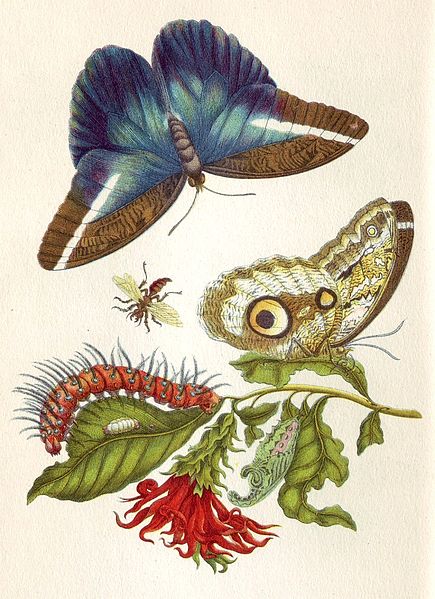
When celebrating the contributions of some of the great women in history, it is often easy to overlook (among all the humanitarians among great women) the women who were involved in the documentation of natural history such as Maria Sibylla Merian. Maria, a naturalist and scientific illustrator, was not only one of the first woman to be actively involved in the field of natural history (then considered a primarily/if not exclusively male domain) but also the first to carefully observe and document the life cycle of insects thus making her one of the most significant contributors to the field of entomology. It is therefore of much appreciation that Google chose to feature, and celebrate her life yesterday by changing their header in commemoration of her 366th birthday. 

Early Life

Maria Sibylla Merian circa 1700
For much of her early life, Maria Sibylla Merian exhibited a fascination for insects! Having been encouraged to take up drawing and painting by her stepfather, Merian eventually began to utilize her talent to document and illustrate the various creepy crawlies that she encountered. Of particular interest to her, not surprisingly, was the metamorphosis of caterpillars into butterflies and moths. 

I spent my time investigating insects. At the beginning, I started with silk worms in my home town of Frankfurt. I realized that other caterpillars produced beautiful butterflies or moths, and that silkworms did the same. This led me to collect all the caterpillars I could find in order to see how they changed. 

In Holland, with much astonishment what beautiful animals came from the East and West Indies. I was blessed with having been able to look at both the expensive collection of Doctor Nicolaas Witsen, mayor of Amsterdam and director of the East Indies Society, and that of Mr. Jonas Witsen, secretary of Amsterdam. Moreover I also saw the collections of Mr Fredericus Ruysch, doctor of medicine and professor of anatomy and botany, Mr. Livinnus Vincent, and many other people. In these collections I had found innumerable other insects, but finally if here their origin and reproduction is unknown, it begs the question as to how they transform, starting from caterpillars and chrysalises and so on. 

(Foreword from Metamorphosis insectorum Surinamensium)

Contributions to Science 

a plate from Metamorphosis insectorum
Surinamensium
As evinced from her foreword, it would therefore seem that though an interest and study in natural history was quite dispersed at the time, not many people displayed an explicit interest in the origin and life cycles of many of their insect specimens. This in turn might be retrospectively attributed to the common belief in those times that insects were "Beasts of the Devil" and thus, spontaneously generated from the ground. As an amateur lepidopterist, Merian's work with butterflies and moths, and a grand total of 186 insect species might therefore be said to be pioneering in that it was one of, if not THE first work to document insect lifestyle and evolution with such attention to detail.


Plate from Metamorphosis Insectorum
Surinamensium
Conversely though it can be argued that there were some local scholars of the time who had already been aware of the life cycles of butterflies or moths, it could also similarly be opined that not many of them truly understood this process. It was Merian's work, for example, that first illustrated the fact that caterpillars were often dependent on specific host plants and that eggs were often laid close to, or on these plants for ease of the developing larvae.  In addition to her work with insects, Merian successfully discovered and described a whole range of animals and plants in the interior of Surinam. Her classification for butterflies and moths and her use of Native American names to refer to the various species of plants she encountered is still relevant in the field of science today. In fact, the infamous "bird eating" spiders of South American probably owe their reputation and name to a drawing made by Merian depicting such a spider devouring a small bird.

A Curious Woman in a Man's World
a plate taken from Metamorphosis insectorum
Surinamensium

Although much of Merian's work, such as Metamorphosis insectorum Surinamensium, and The Caterpillar's Marvelous Transformation and Strange Floral Food were very popular in high society as a result of its publication in the vernacular, much of Merian's work was continuously largely ignored by many within the scientific community at a time when the official language of science was considered to be latin. Similarly, many male scientists, who had never set foot in Suriname themselves, claimed her to be a fraud. Naturalists like the Reverand Lansdown Guilding dismissed her description of army ants and bird eating spiders stating that "Madame Merian has told a willfull falsehood." Such criticisms and accusations would eventually take a toll on her reputation as a careful observer of nature.

Furthermore, while scientific surveys of natural wildlife were not exactly uncommon at the time, they were usually carried out by men who were already being sent to colonies to live, or work, there. Consequently, Merian's decision to self fund her own expedition in pursuit of her interest raised many eyebrows especially over the fact that she was a woman. Despite the doubt of others, Merian's perseverence and tenacity paid off and in 1699, the city of Amsterdam sponsored her petition to travel to Suriname in South America. During stay, Merian traveled between the various colonies, documenting any plant or insect life she came upon there. "In the era of investigation dominate by the collection and classification of organisms, Merian's organic apporach to the study of natural history was unusual and was not always understood by her fellow scholars," (Etheridge, 2010: 19). Incidentally, her observations on the metamorphosis of frogs was the first to ever be recorded with such accuracy. She also took note of the natives and black slaves that were then employed by Dutch planters and is often quoted to be quite critical of the treatment of the Dutch masters over these people.

Late Life

Plate from Metamorphosis Insectorum
Surinamensium
Barely 2 years into her expedition, however, Maria contracted a case of malaria and was forced to return prematurely to the Netherlands. There she spent her life selling the specimens she had collected and publishing engravings of the plant and animal life she had encountered in Surinam. In 1705, she published the world famous Metamorphosis Insectorum Surninamensium. In 1715 at age 67, Merian suffered from a stroke which greatly affected her ability to work. Not much is known about her later life from this point on except that she is listed in a registry as being a pauper. Merian died, two years later in Amsterdam. Her work was only rediscovered, recognized and reprinted in the last quarter of the 20th century. 


Merian and her work is continued to be recognized in this day and age, and her likeness has graced both the likes of stamps and currency but it is arguable that not many people have actually come to recognize and appreciate her contributions to the field of science with specificity to the field of entomology. As a feminist, and an amateur lepidopterist myself, I suppose you could say that I have come to deeply admire Merian and have a strong sense of appreciation for her work (I even have a few of her prints that I intend to frame and display alongside my butterfly and moth collection someday). Perhaps, when I begin conducting my own field studies in the Northern part of Malaysia, I can undertake a similar personal project of my own! It is therefore with much praise and approval that I publish this post in conjunction with Google's tribute and celebration of her Meria Sibylla Merian's: artist, amateur lepidopterist, woman.


Tuesday, April 2, 2013

Butterflies and Moths collections update

Hey ya'll

I couldn't help myself. I did it! I know I was planning to wait until I had a proper display case before I removed the butterflies and moths from the spreading boards, but I just couldn't help myself. The anticipation was killing me and since I had extra tupperwares lying around I thought to myself "why not?!" Anyway here they are! Most of these lepidoptera are Malaysian but there are a few exceptions that come from mainly Europe, Africa and South America. Mind you, these insects were donated most generously for my collection by Mr Khalid Fadil, who is perhaps one of the more knowledgeable butterfly-moth persons in the country. Meanwhile, I hope you enjoy the compilation as much as I did.


Correction: This is really Eupterote naumanni

Craetonotus gangis

Eacles imperialis


Delias caenus

Delias ligata


Cheers,
Cyren

Monday, April 1, 2013

Wild Sex

Hey ya'll

Today I'm going to talk about wild sex, and I mean literally, "wild" sex. For many humans, sex is a pleasurable, very intimate event that often takes place when two individuals develop a strong physical (sometimes emotional) attraction for each other. In the animal world, sex is really anything BUT intimate. In fact, most sexual encounters between animals are violent, forced, and sometimes downright disturbing! For example did you know:

  1. Cats have spines on their penises. This means that they literally end up "stabbing" the female from the inside out every time they withdraw! And you wonder why cats are so noisy during the mating season!
  2. And speaking of weird penises, did you know that ducks have penises too? Yep! It's long, and curly and falls off at the end of the mating season! But no worries, the ducks can always grow them back  during the next mating season and dig this: they can even make them 25% longer to compete with the size of other ducks!
  3. To accommodate the spiral penis of the male duck, female ducks actually have corkscrew cloaca (that's their pee-poo-egg holes) and the reason they do is that when a female is really into a male,  she will grind her body against his and what this does is that is allows his penis to go further and deeper within her.
  4. Wolves have penises that swell. This means that every time a pair of wolves copulate the male LITERALLY gets stuck inside the female and there he will stay until he can ejaculate which can take up to 30 minutes at a time!
  5. And last, but not least, Nautilus and some Octopuses have a modified tentacle that is really a detachable penis. This tentacle can break off from the male animal and swim around in search of a female. This has led many biologist to have considered the penis a separate organism. Looks like sharks are really the least of your worries huh? 

For more interesting (and maybe a little bit disgusting) but mostly funny wild sex facts, do check out Dr. Carin Bondar PhD or check out the Wild Sex youtube webseries. I'll even post the first episode here to start you off. 


*Wild Sex Updates
  1. Heliconius butterflies are sometimes known for cradle rape! Male butterflies generally emerge a lot earlier than females and often gather to camp on sites where female chrysalids are present. When the female emerges, the males all jump on her in an orgy of lepidopteran sex! They pry open her genitalia with their abdominal claspers and proceed to mate with her in a frenzy of wings! Even before her own wings are expanded! 
  2. In a related story, male heliconius butterflies also sometimes rape the females of other, but similar, butterfly species, and they sometimes do this when the female butterflies is still in her chrysalis. Since the genitalia of insects are often species specific, the trauma of the rape often ends up killing the immature female butterfly within. 
  3. A pig can orgasm for almost 30 minutes.
  4. Boars have a corkscrew shaped penis when they are aroused
  5. Chickens can sometimes have such fervent sex that the feathers surrounding the female's cloaca begin to fall off as a result of the friction and trauma. 
*last two courtesy of Tempus*
Enjoy!
Cyren.

Saturday, March 30, 2013

Visit to Happy Bee Farm

Hey ya'll

I hope everyone is doing well! This update is perhaps coming a little late but it is really the first time since the middle of this month that I've had time to compose anything so here goes! Two weeks ago, for my 24th birthday, Ray and I decided to do something different and took a drive up to Gohtong Jaya (which is the halfway point to Genting Highlands. There, we decided to visit the newly opened Insect Zoo, also known as the Happy Bee Farm. The farm itself is perhaps more of a roadside attraction than an actual insect exhibit but though it was small, the trip was rather interesting in its own way! Upon purchasing our tickets at the farm's entrance (I can't quite remember how much we paid to go in) we were assigned a guide who showed us around the farm and explained the exhibits. Although quite taken aback by this arrangement at first (most insect farms do not assign such tour guides to their visitors) I grew to be quite grateful of it as the guide's help and introduction to certain exhibits were invaluable. He showed us, for example, the various equipment associated with bee-keeping from the basic smoke guns, to the more complex structure of Queen barriers (intricate barriers made out of wood that are placed between specific cells in the hive to prevent the Queen from initiating swarming behavior). It was all rather interesting and sincerely made me consider a career in apiary if the whole PhD thing doesn't work out! We were also able to visit the stingless bee hives and sample the honey fresh from the individual cells! 

The farm's European Honeybee colony (Apis melifera)
Contrary to my expectations, the farm did not have an aviary-style butterfly enclosure, but to make up for that they certain possessed a wide variety of other insects! The best part about having the guide came during this part of the tour as we were able to interact and hold some of the insects!!! There was a small cage filled with chrysalids (I counted several common papilio species such as polytes and demoleus, euploea sp., and hypolimnas bolina) as part of the exhibit and we were also able to assist with the releasing of the already emerged butterflies!  


It was IMPOSSIBLE not to fall in love with this Elephant beetle (megasoma elephas)
The farm also boasts, typical to most insect farms of such a nature, an insect "museum" featuring specimens of butterflies and beetles from all over the world. 


The best part of the entire trip, perhaps, was when we got to visit the backroom! Here they showed us all the insects they were presently breeding and specimens that were being spread and dried! They were even willing to sell us a few for the right price! Unfortunately, due to my current lack of funds and indecision, we ended up buying nothing! A few papered swallowtails caught my eye but the price was not right and they only had males besides. The farm also possesses a souvenir store where you might purchase ready-framed butterflies, insects, toys, and a myriad of honey based products.


In summation, I would say that the Happy Bee Farm is worth a visit if you are the kind of person who is into insects, creepy crawlies, and other such creatures! Though it did not boast a grand operation on the scale of what one might find at the butterfly park in Kuala Lumpur, or up in Cameron Highlands, perhaps, the friendliness of the staff and the experience of getting up close and personal with some of these insects (and not just from behind the glass box) truly made up for everything! In fact, I think I will be paying them a visit again sometime soon to maybe buy some of those papered butterflies, beetle larvae, or mantis eggs after all!!!

for more info you can visit their Facebook Page.

Cheers,
Cyren.