Showing posts with label Papilio Polytes. Show all posts

Thursday, June 7, 2012

Butterfly Hybrid Project pt. 2 ~ Setback and Unexpected Surprises

Hey ya'll

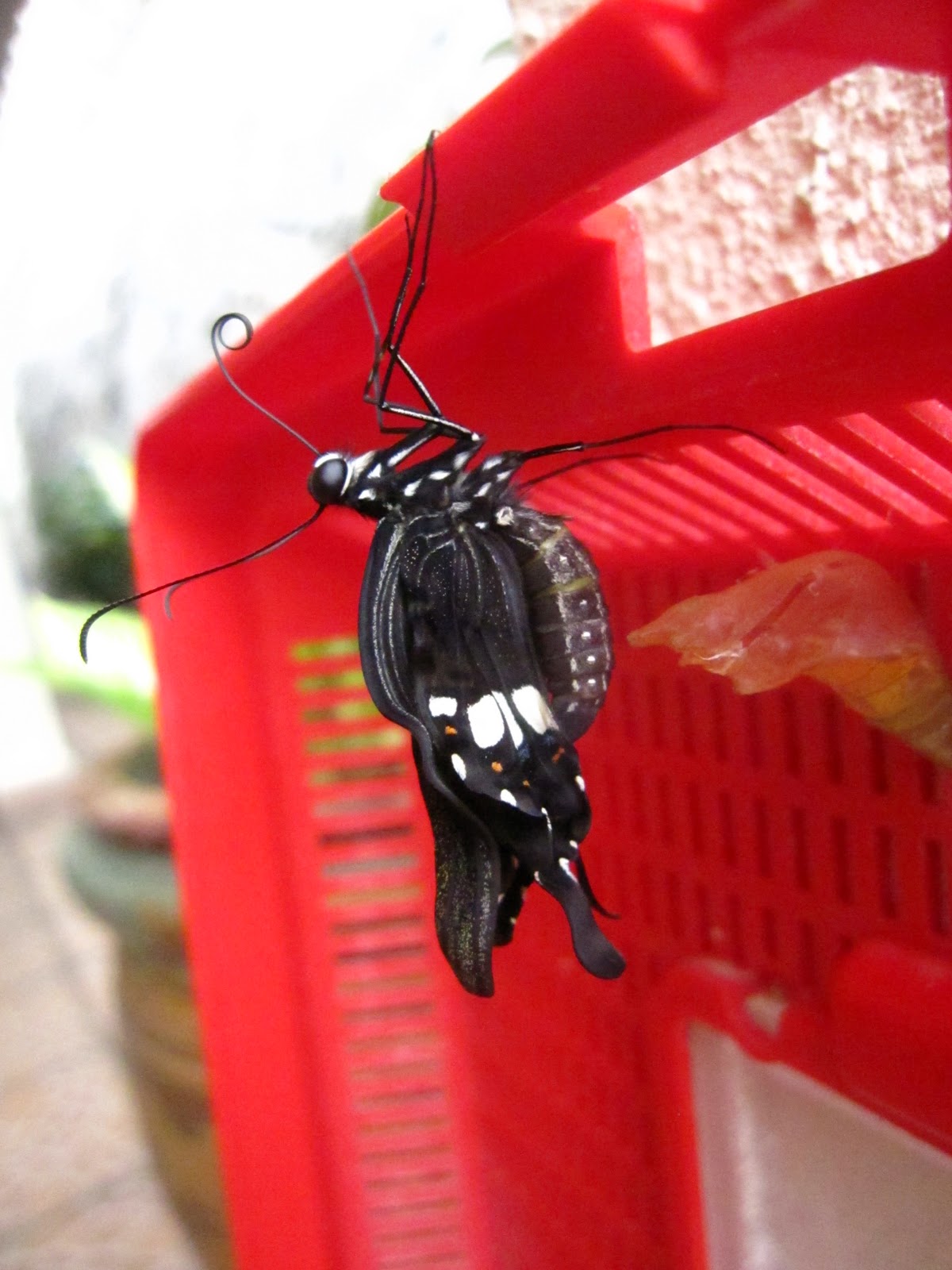
Unfortunate news. Though I have been feeding and caring for them in a routine fashion, the male butterfly that hatched not 2 and a half days ago was found dead in the flight cage for unknown reasons. Perhaps the temperature at night was too low for its liking, or perhaps it was just an unhealthy specimen but either way I found myself with one robust, healthy female, but no male to mate her with. As you can imagine, I was quite disappointed (though part of me told myself that perhaps this is a sign that this just was not meant to be). Either way I was about to release my female into the wild (so she can find her own suitor) when lo' and behold... she started laying! Why, I must admit I was taken completely by surprise! Was it possible, that the two different species of swallowtails mated in the flight cage on their own accord when I was away? Or... is it possible for female butterflies to lay unfertilized eggs (the same way some birds and mantids do)? I suppose there is only one way to find out... keep the eggs, and see for myself. I waited half an hour until she had stopped laying and  then rubbed her abdomen against the leaves, causing her to expel two more. By the end of this process her bulbous abdomen had shrunk somewhat and when I was sure that there were no more eggs in her, I released her into the great outdoors! Good luck my baby, and I hope you find your way out there!!! As I released her, two rather large swallowtails, Papilio memnon and Papilio helenus swooped down from, oh I don't know where... and fluttered about around her!!! Seems like this baby of mine somehow has a knack for attracting diverse suitors!!! Oh well, to each her own! 


On a separate note, I will be expecting a parcel to arrive in a few weeks time. They should contain, among other things, several coveted (by myself) papilionidae butterflies that would no doubt be precious jewels to my collection. I do not wish to reveal them (lest I spoil the surprise!!!) but I can say this much: that two pairs of them are going to be birdwings from Papua, the other six are Parides from Southern America. Oh I can't wait for them to arrive!!! I feel like a child again, in the last few weeks of the year... waiting for Christmas... in June. 

Cheers,
Cyren

Wednesday, June 6, 2012

Butterfly Hybrid Project pt. 2 ~ Advice and Well-wishes?

Hey ya'll

the second butterfly had eclosed by the time I got home and I am pleased to report that it is indeed... a MALE. Mazel tov, it's a boy!!! From what I have read online, the males need about 3 days or so to mature before they are ready for mating (I am presuming that their anal claspers don't work or "loosen out" until them) so in the meantime (while I wait for this Saturday afternoon to try anything), I will just continue to care for and feed the babies while watching and reading up all I can to refresh my memory on hand pairing!!! What I do not understand so far is the concept of squeezing the male's abdomen so that the anal claspers will open... how hard do I have to squeeze? And at which point? If anyone of you here has any experience doing this, any help would be hot. 


Not sure if they are eating or not, but both butterflies expelled transparent liquid from their bottoms shortly after so I take that as a good sign. 
Cheers,
Cyren

Tuesday, June 5, 2012

Butterfly Hybrid Project pt.1

Hey ya'll

The first butterflies eclosed from their chrysalids today. The first one (which seems to be the only P. polytes pupa I have... which is strange considering the sheer number of caterpillars I raised this season) hatched around 5am this morning, fooled perhaps by the 24/7 UV light that shines on its cage and the second one is due in a couple of hours time, possibly when I am at work. An unfortunate, but anticipated twist in the turn of events is that the P. polytes that eclosed first was a female. This puts a cramp, somewhat in my breeding operation as I would have preferred to have my females as fresh as possible. No matter, if the chrysalis at home turns out to be a P. demoleus male, all is not lost and I daresay I can attempt breeding them some 2-3 days later.  As it stands, I can only reduce the temperature in the room and make sure that the female remains as inactive and healthy as possible. 


I've started feeding her with a solution of 15% sugared water but am thinking of "kicking it up a notch" with 100 Plus or Gatorade as I have read online that these make much better nectar substitutes. As it stands, swallowtail butterflies can be notoriously difficult to feed in captivity (they seem to have trouble feeding from artificial flowers soaked in the sugary solution) so hand feeding is sometimes necessary. As is what I did today. The set-up may look quite appalling but it is really quite harmless and is really designed to prevent the butterfly from getting its wings and legs "contaminated" by the sticky syrup thus hindering its movements/damaging it. 

Eat up my baby!
Anyway I am really hoping this project can come to fruition (am curious and anxious to find out what kind of butterfly will result from the pairing of these two... indeed, if such a pairing were even possible to begin with) but we can only hope for the best! Stay tuned for updates!!!

Cheers,
Cyren

Sunday, April 1, 2012

Back to Butterflies

Hey ya'll

I was clearing out the extra files in my camera's memory card today when I came across these.

Common mormon (Papilio polytes) female
Common mormon (Papilio polytes) male
It's been so long since I last raised butterflies and seeing these pictures just makes me want to start all over again!!! Unfortunately, I did not breed any from my latest stock... in fact many of them died from fungal infections... and the swallowtails have not seemed to return to our garden yet this year... I suppose this just goes to show that no matter how much I may "stray" with my interest and captivation of other creepy crawlies, it would seem to be that my number one passion will always be my winged obsession with butterflies. 

Cheers,
Cyren

Wednesday, February 8, 2012

February goes to the Swallowtails

Hey ya'll

I am so excited! I can't believe it is only just three more days before I finally get to go on the vacation I've been jabbering about for the past three months! Three more days and I will be embarking on the trip I've had planned for the past three months: three full days of rest and rejuvenation in the cold mountainous air of Genting Highlands... hmmm, I suppose good things really do come in threes! And speaking of good things the passing of the Chinese New Year has brought with it, as it usually does, a population boom in the swallowtail butterflies!!! I suppose all that citrus being imported into the country has catalyzed in a lepidopteran orgy of epic proportions. Why, just yesterday I found several common mormon females (Papilio polytes) and red helen swallowtails (Papilio helenus) ovipositing on my lime plants. I didn't have much time to observe and harvest their eggs but I'll check back in a few days to spot the larvae.


On a more sour note, I'm experiencing first hand the terrors of damp on a lepidopterist's collection. Several butterflies that I have kept in storage (some of which I intended to trade with an Italian collector later this year) had somehow gotten damp (despite the copious amounts of silica gel and charcoal I placed inside) and are now sprouting fluffy white fungi! I've since treated many of them with nail polish remover before leaving them to dry thoroughly but I'm afraid some of them were so damaged that they had to be thrown away... in the meantime, it seems that the moisture acted as a humidifying chamber because many of the butterflies were as pliable as if they had just died an hour ago! I even spread one as an experiment. Glad to say that none of my butterfly display was affected by this, and thank goodness too! I have some rather prized  (and irreplaceable) specimens there... 

Assorted butterflies and moths being spread for display
On an ending note, Ray is studying a particularly interesting subject this semester known as Pet Psychology, and the stuff on Animal Assisted Therapy aside, it is actually pretty cool because they get to meet and greet with a whole lot of creepy, crawly and sometimes slithery creatures up close and personal! Last week it was snakes. Today it was tarantulas! Gee, I can't wait to hear what they will encounter next?! Meanwhile, we often joke that he is fortunate that he has me as my knowledge on these things would no doubt come in handy!!! In the meantime, I should probably do something more with this influx of swallowtails... maybe if I have the time I'll try to make a species count everyday. I heard there's a way to mark butterflies by sticking small stickers on their wings (they do it in some places to keep track of Monarch populations). I wonder if I can improvise something here. Perhaps, but more research is needed. Till next time.
cheers,
Cyren.

Thursday, December 2, 2010

Inter-species Mimicry in Butterflies

Hey guys!

Another butterfly hatched from my nursery today making that a total of some couple hundred butterflies that have been raised successfully in my home-made butterfly house thus far and many more on the way. However, with my departure to Angkor Wat for four days next Friday I have to come up with some alternatives to provide for my insects (food for the larvae, of course) but special provisions to be made for someone to come and check (and release) any butterfliess that may have emerged while I am gone. Meanwhile, take a look at the beauty that was born today. The much awaited Common Mormon female.

Common Mormon (P. Polytes) female

I really love raising these butterflies! Not only that they are fairly easy to raise (they feed on the same foodplants as the more common Lime Swallowtail) but the females have the most beautiful patterns on their hind wings consisting of multiple red spots that can take many different forms. Its like waiting for the the lottery to happen!

The red spots can be sparse, such as on my current specimen

Or more vibrant, like this.

The red spots on these butterflies were actually made to mimic another species of butterfly alltogether. The Crimson Rose butterfly (another one of my favourites) that is poisonous and therefore unedible to birds and other predators. The Common Mormon female (carrying the eggs and thus, the lifeline of the butterfly species) has evolved to mimic the wings of Crimson Rose butterflies thus avoiding being eaten. To the trained eye, however, these two butterflies can be distinguished quite simply. The Crimson Rose, as its name suggests come from the family of red-bodied swallowtails that is to say their bodies are colored a brilliant red, advertising the poison that actualy runs in their blood.

Crimson Rose Swallowtail
Insects have been mimicing each other for centuries, perhaps even millenia and predators, who are born with these instincts hardwired into their genetic code learn to leave the poisonous, and the poisonous looking ones alone. Why only some species exploit this to their advantage and why others do not, is still a mystery.

Monday, November 29, 2010

Swallowtails in Flight


Hmmm there seems to be some problem with the sound (it skips at about 40 something seconds) but otherwise check out this latest video I made of my latest butterfly. Also, I found this rather cool video of a swallowtail butterfly in flight done in slow motion. Different species, however as this is a Jakou-Ageha (Byasa Alcinous) from Japan.


"Like many other members of the insect world, the lift generated by butterflies is more than what can be accounted for by steady-state, non-transitory aerodynamics. Studies using Vanessa atalanta in a windtunnel show that they use a wide variety of aerodynamic mechanisms to generate force. These include wake capture, vortices at the wing edge, rotational mechanisms and Weis-Fogh 'clap-and-fling' mechanisms. The butterflies were also able to change from one mode to another rapidly"

Saturday, November 27, 2010

Eclosure of a Swallowtail Butterfly *photo sequence*

Hey guys!

It's been almost a week since the parental units left for their second honeymoon in Sydney, Australia and it will be about a day or so before they return. In the meantime, I've had a taste of what it would be like "holding the fort" all on my own and let me tell you, without someone there to prepare your meals for you all the time well... let's just say its very tempting to resort to a less-than-balanced diet by eating out and snacking off instead! Guess whose having pizza (again) for dinner tonight!!!

Anyway another one of my common mormon chrysalids eclosed today, was really happy to see it but its a pity that it was (yet again) another male which means I still don't have any females with which to breed them. No matter he's such a beautiful specimen and I am particularly fond of this species (mostly because it is relatively easy to breed but also because of the lovely tails on their hind wings)
These are two of my un-hatched chrysalids. The Common Mormon Swallowtail
 chrysalis on top the lower one belongs to a Lime Swallowtail.

Common Mormon chrysalis about to eclose. I love photographing chrysalids
at this stage of their development. It shows you the butterfly all snug and
waiting for its time inside its cradle.

And the moment arrives! With just the slightest, almost inaudible, cracking sound the top of the
chrysalis splits open and the butterfly tastes for the first time, the sweet scent of air.

He wriggles about and works his legs, head and antenna free, knowing for the first time
in his life, what it is like to see and visually sense the world around him.

Carefully, the butterfly hoists himself out of the chrysalis. His wings are still damp and limp from his two weeks
of incubation and so he uses his legs to crawl to a high ground to avoid predators but also
to ensure that the tools of his survival will properly develop in this crucial stage.

As he hangs from his chosen perch, seemingly motionless, his heart begins to pump blood, or
more specifically hemolymph into his veins, stretching his wings out to their full extent.
As his wings reach their full capacity, he begins to open and close them. Carefully making sure that each
wing will function the way it is supposed to. Eventually the veins in his wings will harden and form
the skeleton that is the wing-frame and he will be able to fly and fullfill his destiny,
from flower to flower, garden to garden.

All in all a succesful eclosure and I am very proud of my little-one for coming this far! Indeed, it doesn't matter how many succesful eclosures I witness, each one still brings the same ammount of joy and pride to my heart! Unfortunately, because it is a rather damp and rainy day today this one will have to stay indoors and feed (for now) upon my home-made mixture of butterfly nectar until tomorrow comes.

Feeding from my butterfly-feeder
The proud father to a new-born butterfly :D

Monday, November 1, 2010

The Butterfly House pt. 2 ~ Case of the Mysterious Mormon

 
A picture of the eggs I collected.
These were wild specimens

The bunch of caterpllars. All of
these, except one turned
into Citrus Swallowtail Butterflies

A couple of months ago an incident occured in my Butterfly House that was quite unexpected but much welcome. This happened sometime after my 7th or 8th brood of caterpillars. The lime plants were beginning to flourish and bear fruit, the flowers - though certain species needed to be replaced when they matured - were thriving and the Citrus Swallowtail butterflies more abundant than ever. It looked like the breeding waystation has finally came to effect and I cannot help but wonder if some of the butterflies I am seeing today (those that have bred in the wild, outside of my enclosures) are not the grandchildren or even great grandchildren of the butterflies which I had released earlier in the year! Which then begs to answer the question, do Citrus Swallowtails inherit within them some sort of genetic memory with which they pass on to their future generations containing within it information of breeding sites and feeding grounds and things like that. Sounds too far fetched? I think not! Monarch butterflies for example are quite known for their annual migration from the North, to the South of the Americas, a journey that will span about three generations of butterfly. The amazing part of it all is that the butterflies fly, generation to generation, through the same routes, stop at the same feeding/breeding stations and end up at the same patches of forests year after year! What this basically means is that butterflies who have never before made the long journey across the continent will, somehow, instinctively know the way. Perhaps such behaviour exists to an extent in all butterfy species? But that will be a question to be answered at a later date.

But I digress. In checking up on my chyrsalis box I noticed a few butterflies had hatched and upon closer inspection discovered that one was quite different form its "siblings". Carefully cupping the insect in my palms I brought it upstairs into my room where the cool-air from the airconditioning device left it unactive. I was eventually able to identify it as a Common Mormon butterfly (P. Polytes) and a male at that too which was surprising considering that at the time I was only breeding Citrus Swallowtail butterflies (P. Demoleus) and the larvae I had been collecting from the wild (to add new DNA to my captive genepool so that no inbreeding occurs) were all of the Citrus species. A little bit of researching answered that question. It would seem that the larvae of the Polytes species mimics - almost remarkably - the larvae of the Demoleus species and while this is not a surprising feat in itself - butterflies are masters of mimicry and often mimic leaves, twigs, other animals and even each other to protect themselves from predators - the question is, to what advantage would it be for the larvae of one species to mimic that of another? Demoleus larvae are not only non-poisonous, as a matter of fact are easily recognised and heavily parasited by various species of wasps! How could the Polytes larvae possibly benefit from such a form of mimicry... Perhaps it is some remnant of an evolutionary past, an inherited trait similar to that of the Monarch Butterflies. But surely there are some deeper workings at play here, something in the vast web of nature that has not yet been discovered and at every turn these butterflies are beginning to surprise me even more every day. so many questions left to answer... but for now, I will keep my eye out for Polytes adults breeding in the garden, perhaps I can add this butterfly (with a very beautiful female form, I might add) to my repertoire.
left, the chrysalis that would eventually hatch into Polytes, right, the regular
Citrus Swallowtail Chrysalis. *note* the Green form exists in the Citrus
breed as well. The pupa colour is dependant on the season.


A comparison of the two adult butterflies. On the left, Common Mormon (P. Polytes)
on the right, Citrus Swallowtail (P. Demoelus)