Showing posts with label Plants and Flowers. Show all posts

Saturday, December 27, 2014

Back from The Field: Reflecting on 2014

Hey ya'll

I have just returned from the field where I spent the better part of 2014 living with the Semai people. The Semai are one of the 18 officially recognized tribes of Indigenous Peoples living across Peninsular Malaysia and by far the most numerous and widespread. The people that adopted me into their village, and later on their homes, were from the Bukit Kinta Rainforest region of Gopeng in the state of Perak, Malaysia which is a stretch of forest that borders the Titiwangsa Mountain Range (upon which the famous Cameron Highlands is located). The Semai people of the Bukit Kinta Rainforest region were spread out over three villages, Ulu Kampar, Ulu Geruntom, and Ulu Geroh. The family that I lived with the most during my time there was from Ulu Geroh and I had been sent there by my University as part of the data collection segment of my PhD to study the customs and culture of the Semai tribe, as well as note their contributions to the conservation of local flora and fauna the most notable of which were the iconic Rafflesia flower (Rafflesia cantleyi). 

Rafflesia cantleyi is perhaps one of the smaller species of Rafflesia flower but what it lacks in size it most certainly makes up in color.

I was adopted by a small family whilst in Ulu Geroh and was welcome to stay with a warm and affectionate woman and her daughter in their small one room house (for ethical purposes I shall refer to them from this point on as my Foster Mother and Foster Sister). The women of the Semai tribe are worth mentioning as some of the most resilient and resourceful people I have had the pleasure and honor of interacting with and my Foster Mother was no exception. Even during the early weeks of my initial stay I could tell that this was a woman who was used to working for what she wanted without having to wait for the affirmation or assistance of others to achieve it. My Foster Mother lived alone with her daughter ever since her husband passed away (her oldest child, her son, had married, moved out, and had fathered kids of his own by then) and had taken it upon herself to give her daughter everything her own parents had taught her were important in life: an education, a goal, and a future. To put her daughter through school, and to ensure that she had enough money when the time came for her daughter to go to college, my Foster Mother moved out of the small town house she had been living in with her husband, and back into the village of her ancestors where she hoped she would be able to make a decent living off of the land to support herself and her children. From rubber tapping at the wee hours of the morning (sometimes, with my Foster Sister *then an infant strapped to her back ) to raising her own flock of chickens, to other odd jobs such as catching butterflies and other insects for collectors, my Foster Mother has done it all.  She was also one of the first members of the village to become actively involved in Nature Conservation and is one of the longest founding members of SEMAI, a coalition formed by the villagers dedicated to the promotion of community-based eco tourism and environmental conservation, that is active to this very day. 


My Foster Mother's house


A photo of the neighbor's house and the surrounding forests which would often be beautifully misty in the mornings.
Most homes are well equipped with a gas stove but many Semai people still prefer to cook their meals traditionally over an open fire from time to time. 

The implementation of community based eco-tourism and environmental conservation in the Ulu Geroh village is a fairly recent thing and can be traced back to just slightly over a decade ago. The efforts were first officially sponsored and supported by the Malaysian Nature Society, but has since received sponsorship from various other bodies including the International Union for Conservation of Nature (IUCN). The SEMAI coalition was formed as part of a then-radical movement to make indigenous peoples the main stakeholders and decision makers of how best to implement Nature Conservation strategies and eco-tourism within their ancestral home land and their community. Today, SEMAI operates completely independently from any official sponsor but do continue to enjoy the support of various educational institutions and non-governmental organizations. The full story of SEMAI's formation and the growth, trials, and tribulations of its implementation of eco-tourism and nature conservation in the village is a lengthy one which I will not discuss here but I do wish to note that one of the things that I stood out to me the most was that the Semai people have always had a close relationship with the natural objects in the world around them. This, in itself is not something that is particularly remarkable and indeed, I suppose the same is often said of indigenous communities world wide. But while I had always taken for granted the "spiritual"ness in which this connection might take place, the community surprised me by showing how even the most mundane things: like the act of eating, is intrinsically tied to the various features of their ancestral homelands and so, their identities as well.  Certain forest plants, for instance, that are consumed for food, are associated with various stories of the Semai tribe that have been passed down for generations. These stories have largely withstood the tests of time and have prevailed despite factors such as modernization and the conversion of many of the Semai peoples to Christianity. By consuming these plants instead of what they call "city-vegetables" (referring to commercially cultivated greens) the Semai people are able to reconnect with their roots by accessing some form of collective based memory/imaginary that reinforces their unique identities as members of a particular indigenous tribe.

The Community Eco-Tourism Center was constructed more than 10 years ago from what was an abandoned Surau  (Muslim prayer building) that was provided for the villagers by the government. It now also serves as the village's Community Hall and important occasions such as meetings with NGO representatives and "village trials" are commonly held there. 
Living out in the forests with the indigenous peoples was something that I have always wanted to do all my life, and though I expected that there would be certain challenges along the way, some challenges that I anticipated were a lot more difficult than others. Going to the toilet, for example, was something that was particularly tricky to master in those early days. Many Semai settlements are constructed alongside rivers or other such fast moving bodies of water. As such, there didn't seem to be much need for Semai households to construct bathrooms or other such areas where one might discreetly eliminate waste. I can attest to this: squatting in the middle of a fast moving river, in full view of any person who might potentially pass by, all the while trying to balance precariously on mossy rocks is not the most conducive environment for waste elimination. Particularly when nature decides to call in the middle of the night. There is nothing quite so "frightening" as squatting on a slippery rock in the middle of the river in the middle of the night in pitch darkness. There's always the constant fear of falling into the river and being swept away by the current (particularly if it has been a rainy day), or being attacked on one's sensitive areas by any number of wild animals or creepy crawlies that might be lurking in the darkness. When I was not watching out for my behind (literally), though, the river was a fun place where people commonly headed to to cool off, especially during the dry season when there was not a cloud in sight and the weather could be most unforgiving. Of course, as common sense would dictate, any frolicking or "bathing" in the river was done much further upstream, away from where any elimination activities might take place.


Some of my closest friends in the village were the children, who often knew the best places to go to in the surrounding forests, whether it be to find turtles of fresh water shrimp, or to see the most beautiful waterfalls.  Many of these children, I would be told later in my stay, commonly referred to me as their "big brother" and would commonly seek me out when they were on holiday from school. 
Being a nature lover and an amateur lepidopterist, I kept a field journal studiously and recorded the various species of butterflies, insects, and animals that I encountered there. Fortunately for me, my Foster Mother was a woman who did not shy away from animals and indeed, kept a small flock of poultry (a mix of turkeys, guinea fowl, jungle fowl, and domesticated chickens) around her house, as well as several ornamental birds, parrots, and cats. This collection grew steadily and remarkably during my stay there. My Foster Mother would later confess to me that she felt more confident raising a larger variety of animals because I was there to provide the information and show her how. Having learnt about my love for butterflies from some of my sketches, she would also invite me out into the forest (especially during the first few months of my stay) whenever we had nothing to do around the house to search for butterflies and other insects for me to draw. Along the way, she would also enlighten me about the various plants we encountered. In this way I quickly learnt which leaves could be used to stop bleeding, or which flowers when chewed, could produce a numbing effect not unlike that of a moderately strong local anesthetic. My Foster Mother educated me in the ways of traditional indigenous medicine and passed on to me, as it was passed on to her by her father, the herbs one might use to produce a soup to cure fever, and the roots and spices needed to form a poultice that is beneficial for women who have just given birth. She also enlightened me on the different leaves, fronds, and woods that were commonly used by the Pawang (shamans) for spell casting and delighted me with stories about the various kinds of spirits that inhabit the forest as well as the appropriate methods of avoiding their wrath or mischief. The Semai tribes have a very different view on spirituality than most as spirits are considered beings that are of this world and are as real as say a tiger, or a tree. They are often spoken of as a matter of fact and almost never in a metaphorical or symbolic sense and though the worship or petition of spirits is frowned upon by most members of the community who have converted to Christianity, belief in such spirits continues to this day and traditional indigenous methods and knowledge of dealing with malice associated with said spirits are sometimes preferred in lieu of a Christian exorcism or prayer. Such a concrete belief in spirits has a profound effect on the community, typically when community members' fears of having transgressed in a particularly spiritual or "haunted" area is manifest in a "possession" of sorts: often diagnosed by symptoms such as unexplained violent outbursts, sudden change in personality or disposition, and hysteria. During my stay at Ulu Geroh, I attended no less than 6 such sessions.


Some of the animals from around the house
The Malayan Lorikeet/Blue Crowned Hanging Parrot (Loriculus galgulus) is a very significant bird in the Semai people's spirituality as it is believed to be one of the "good" animals that wards off the "dark" creatures. Certain insects, such as butterflies are also considered significant spiritually because they are believed to be the "pets" of certain powerful entities that have control over natural phenomenon like the weather.
Saying "hi!" to a particularly friendly sunbird. 
Also, due to a combination of factors: and abundance of the right host plants as well as several mineral springs in the surrounding forests, Ulu Geroh is constantly visited by BUTTERFLIES!!!


MORE butterflies...


And more butterflies than I ever thought I could see in the wild, all in large numbers and in one place


All in all, I'm going to conclude with saying that 2014 is ending on an all time high! Sure I did not come out unscathed (indeed I don't think some of these battle scars will ever heal) but what is an adventure without a few bumps along the way? And to top it off, I think I just fulfilled my New Year's resolution: to be a stronger and braver person than I was the year before. Personally, I think that I have exceeded my own expectations and more! So on that note I wish you all a very happy new year and shall leave you with these pictures of some life long friends I've made along the way: 


Blessed Be
)O(

Tuesday, June 4, 2013

Never Forget

Hey ya'll


What's really sad about the state of the world today is that people always complain about how ugly it is, or how corrupted... about how all beauty is lost, when the fact is that that couldn't be any more further than the truth! Beauty still exists. Despite all we've done to the planet, it's still there.  Want to try to find some beauty in your life? Try to be more observant to the things around you. 

Beauty is everywhere. The problem is most people these days don't bother to look. We expect beauty to be presented to us on a silver platter, or a silver screen, the way we are so used to being entertained by our computers, television sets, and smart phones, and so are equally quick to judge the "world" as an ugly place when its beauty is not readily visible to our eyes.

But I challenge you today, to take a walk around your neighborhood. When you've found a comfortable spot, bring yourself down to the level of the Earth. Now, I want you to observe a blade of grass. Pay attention to every detail of it, the way it grows out of its roots, the shade of purple in the smallest petals of the impossibly small flowers, the delicate wisps of fur that sometimes grow from the stalk. For a brief moment try to appreciate the complexity of it. Remind yourself that this is not "just a blade of grass" you are looking at, but a living thing. An organism with a complex system of cells and processes that contributes to the life giving oxygen that we all breathe.  And then try to look even further, observe the many creatures that frequent that blade of grass.

There are always ants of course, but if you look even closer you might see other things. Woodlice, perhaps, that can roll into perfect spheres when they are alarmed. Or maybe even the almost microscopic creatures. So small that they would seem like "insects" to the already diminutive insects!  Sit there for fifteen minutes or half an hour or so and take note of the various activities these animals partake in, so busy in their own tasks, or too small to may anything else any significance. I hope it won't take you too long before you realize that there is an entire world that is centered upon this blade of grass! Now take a step back and look all around you.  Take in every single blade of grass in the area, each containing its own secret little society. Take a step back further and think about this on the scale of the entire neighborhood. There are multiple "worlds" within our world, so close to us and yet so invisible from our own. Each blade of grass is its own community, each garden, a world, each patch of green, a universe! 


My friends, there is beauty everywhere (especially where there is a little Green!). One only need take the effort to look. 

Life History of the Monarch Butterfly (Danaus plexippus).
photo source: http://cyrenization.deviantart.com


Thursday, July 26, 2012

Plant in a Pod


Hey ya'll 

so our dear friend Caryn just came back from a rather eventful trip to Korea last week, and along with her she brought a very new "friend" into our lives; Plant in a Pod!!! 


The "Plant in a Pod" is literally what is sounds like; a small plant in a pod!!! The plant in question is (I'm not horticulturalist so I can only take Caryn's word for this) a kind of remarkably slow growing cactus that requires very little for its survival and therefore, requires very little care. A simple dipping of the bottom half of the pod in water for half an hour or so every 2-3 months will allow the cactus to absorb what moisture it needs to sustain itself. Attached to a length of string or a chain, the "Plant in a Pod" can make a wonderful keychain or even a necklace (as I have fashioned mine) that will be sure to draw more than a few curious stares. Personally I think it looks like something out of Poke'mon or Final Fantasy and gives a whole new (and fun!!!) meaning to the term "adopting a plant". Someone should really consider introducing these here!!! 

Cheers,
Cyren

Tuesday, May 29, 2012

Butterfly Hunting and Other Adventures


Hey ya'll 

I recently made a decision, to just do the things that I want, however "far out" or "unreasonable" they may sometimes seem. Due to the ever increasing certainty of certain circumstances regarding my being, I've begun to realize that all this effort that I am putting into my work right now... all this "stockpiling" I'm doing for the "future" pretty much counts for nothing if I never actually get to witness or enjoy that future first hand, and so instead I've started to learn to do something quite different (to me, anyway!) and that is take some time off to enjoy the present. And today, that is precisely what I did. It all started when I found myself, rather unexpectedly, with the entire morning off! No work. No exams to invigilate. Just a stack of assignment scripts I should be marking but have put on hold in the bottom drawer of my desk. So when a bunch of friends made plans to conduct a little "expedition" to the Forest today morning, I was rather quick to take them up on their most generous offer. I did not regret it.

The trip, though began on a rather dismal  tone as the sky was gray and huge rain-clouds threatened us with rain, gradually began to pick up the pace as the heavier rain clouds slowly blew away to reveal a moderately cloudy but still fairly sunny day. Consequently, as one might imagine, butterflies which were hiding away due to the cold weather of the morning gradually began to make their appearance as the day progresses. Like little dancers they were, in their gaudy and beautiful costumes of yellows, browns and blues, fluttering around and about us in a drunken haze. Butterflies of all shapes and sizes ranging from modestly small common grass yellows (Eurema hecabe) to the larger and more striking butterflies of the crows and tigers families (Danaiidae). At one point, while we were trailing the edge of the lake in search of Nepenthes, I even encountered a very large, and very beautiful female of the Helena's birdwing butterfly (Troides helena). Bug maniac that I am, I was in lepidoptera heaven, and I'm sure that these images will speak out for themselves. 

Common grass yellow (Eurema hecabe) puddling in large numbers
Yellow glassy tiger (Danaus aspasia)
Blue tiger (Tirumala) limniace
Royal assarian (Terinos clarrisa) ventral view
Royal assarian (Terinos clarrisa) dorsal view
Black veined tiger butterfly (Danaus melanippus hegesippus), which (as you can probably deduce from its markings and colorations) is a distant cousin to the famous Monarch butterfly (Danaus plexippus)
Banded imperial butterfly (Eooxilides tharis distanti)
I also took the opportunity to enlighten my expedition mates on some basic knowledge on butterfly anatomy, such as determining sex with non sexually dimorphic species.

No, I was not torturing the butterfly! I was simply showing Joanne and Naomi the "pencil hairs" which just out from the butterfly's abdomen to disperse pheromones during their courtship rituals.

Of course, the actual number of butterflies we encountered throughout the trek numbered more than are displayed here but not all of them were "catch-able" due to a combination of factors (mostly my limited stamina and the butterfly's own skill of grace and evasion). Aside from the birdwing we encountered by the lake, I did not see many other Papillionidae save for several Tailed jays (Graphium agamemnon) and what I think may be a Great Helen (Papilio iswara). What intrigues me most, however, was a fairly large hesperid (or at least, that's what it looked like) that was colored an iridescent greenish-blue that tapered to egg-yolk yellow around its thorax. We encountered only one such butterfly at the start of the trek but it was too quick for me and managed to escape without even so much as a picture shot. Anyone know any species that resemble the above description (however arbitrarily, it would still be interesting to know, so do message me or leave a comment if you do!).  Aside from butterflies we encountered an abundance of other insect life. As you may expect, from a habitat located next to a lake, there was also an abundance of dragon and damselflies of all shapes and sizes, some of which were truly most interesting!!! 

These damselflies, which were small and blue in color, were the most abundant and rather easy to catch. Unlike their kin and cousins (the dragonflies) they seemed to adopt a rather lazy sort of flight instead. I caught this individual simply by reaching out and plucking at it with my fingers.
These extremely colorful ones, on the other hand, were a lot more difficult. They  flitted quite  suddenly away from any approaching object and despite their striking coloration (and it really IS quite colorful if you take a nice long look; green eyes, blue thorax and an orange and teal striped abdomen) they are extremely difficult to spot once they flutter away into the undergrowth. 
But the "best" dragonfly that we spotted today must definitely be one of these. Not quite as abundant in number as the other species, these dragonflies were still undoubtedly one of the more striking ones that were present by the pond. It may not be noticeable here, but under the soft glow of the morning sun, its wings actually SPARKLE (that's right, SPARKLE) with the iridescence of bronzed gold. Unlike other dragonflies it's flight is rather lazy and when perched seems to delight in angling its wings this way and that to reflect the sun (though for what purpose this may be, I really can't say). 


And speaking of insects in the area, I shall not forget to mention the patches of insectivorous plants (that is, plants that eat insects) which we found there as well! They were all pitchers, mainly Nepenthesis gracilis (identified by Joanne), though I daresay if we looked closer and longer we may have found something else and Joanne mentions that their presence in the area is puzzling because they usually colonize places with low soil quality and this forest is clearly teeming with life!!! A possibly explanation however might be the acidity of thel ake water (which was rather murky in a chalky sort of way, suggesting high CO2 content) and these pitcher plants all grew very close to the bank.
Budding pitchers
CLUMPS of pitchers
Against my hand for size comparison
The final half of our trip took us to the "abandoned shack", actually one out of two abandoned shacks, where Joanne and her friend, Steven, had previously found a pair of cinnamon tree-frogs. We had no such luck, though, and all we found when we pulled off the corrugated iron sheet that was covering the opening of a well was a pool of very clear stagnant water. The shack, however, was a different story and was quite a pleasure to explore. I discovered, upon entering that it was more of a medium sized house than a shack. It boasted a fair-sized domicile with an inner courtyard that led to two toilets. Various artifacts of the home's previous life remained in the building. The rotten frame for a bed, and cups and bowls that were so old they had began to cake with dirt and dust. But just as one life had passed from this now abandoned home, other lifeforms have found shelter and now called it home. The entire building consisted of a total of four rooms and all of these, were heavily colonized by bats of various species. I could tell summarily that a large majority of them were fruit bats though there were some of smaller varieties that might have been insectivorous bats (the emitted very high pitched quips that sounded very much like the sounds I've heard bats make when finding their way via echolocation). I could not tell them all apart though, or distinguish any individual species, but you will excuse me as I am no expert on chiroptera. Perhaps, the next time I return to this forest, I can bring along someone who is! Despite our efforts to remain absolutely silent, the bats objected to our presence somewhat, and we promptly made our way out of there the moment we noticed that many of them had began to stir and fly about. Naomi, being the smart one, stood outside but Joanne and I had to deal for a few moments with the rather unsettling over-head flutter of disoriented Bats!!! 

Bats hanging from the ceiling.
Before long, it seemed as if it was too, our turn to head out of the forest. Such a pity, as I could have really stayed in there for hours on end! But there was still work to be done, and I had already enjoyed myself quite sufficiently. I gave a respectful bow to the one that guards these lands, and we began the steady but steep trek down. By the time we reached the base, it was just barely 12.00.

Cheers,
Cyren

Photographs courtesy of Joanne Tong. 

Monday, January 9, 2012

Swallowtails and their Food Plants


Hey ya'll 

It is general knowledge, that the caterpillars of each butterfly species will generally only feast on the leaves of specific host plants, but while the host plants of each lepidoptera species may indeed be as varied as the actual number of flora there are in the world, it does not escape my notice that many butterflies from within the same family actually share similar, if not same, larval food plants as one another. Many of the black bodied swallowtails that I have been raising for some time now, for instance, feed on various species of rutaceae (citrus) plants. Indeed this was something I discovered through something of an accident when a batch of Papilio demoleus (lime butterfly) eggs I was raising hatched a handful of Papilio polytes (common mormon butterfly) larvae as well, which led me to speculate that some wild common mormon female must have deposited her eggs upon the same host plant as the lime butterfly. Indeed, over the years I have experimented on various swallowtail larvae and found out that a large majority of Malaysian butterflies from the family papilio will indeed feed on rutacea, even though their eggs were originally deposited on host plants of other origins. Below are a list of some of the swallowtails I have raised which feed on such:

Lime butterfly (Papilio demoleus)
Common mormon (Papilio polytes)
Great mormon (Papilio memnon)
Red Helen (Papilio helenus)
Great Helen (Papilio iswara)

Needless to say this makes it easier for me to breed these insects as citrus plants are relatively easy to obtain in our country and similarly easy to cultivate. As it stands, I have about ten healthy citrus trees growing in the front yard today which is a reassurance that I will never run out of food for the voracious little larvae! 

Newly eclosed red helen swallowtail (Papilio helenus)
Red helen swallowtail (Papilio helenus) with Common mormon male (Papilio polytes)
As a contemplative end-note, though, I wonder if this is any indication that many of these butterfly species do indeed share a common ancestor, the most basic form of papilio which fed on rutaceae that then diversified as its members spread across various locales and regions across the globe. As I have not much intellectual background on such matters, I can only speculate for now and hope that some day I will come across in my musings, some piece of information that would shed light on the subject as such.

Meanwhile, Term is starting soon which means my first day as a university teacher looms ever closer. Having not yet received even the syllabus for the semester, I am more than a little apprehensive although part of me likes to be optimistic and think... well, I've done all of these subjects before, and aced them with flying colours... how bad could it be? Wish me luck everyone!

ps. Ray will be leaving China today for Sibu, which is in East Malaysia. I heard there's been floods so I hope it won't be too much of an inconvenience.

Cheers,
Cyren.

Monday, October 24, 2011

Sunway University's Community Mental Health Week

Hey ya'll

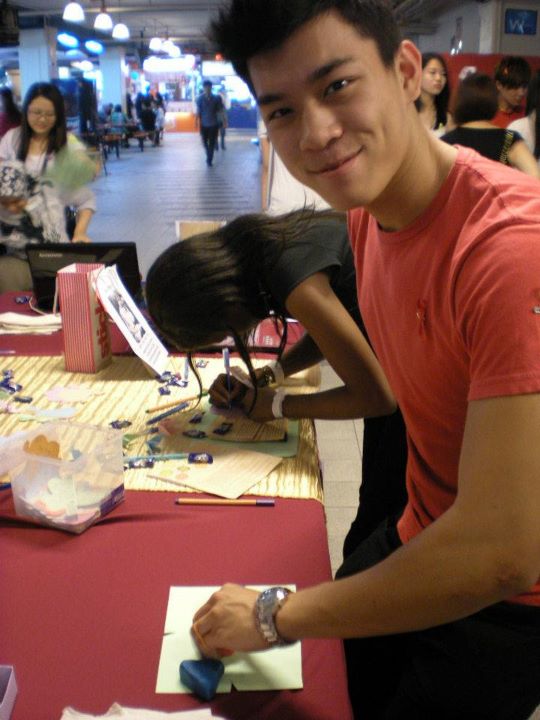
Ray just had his Community Health Week event, which was held in Sunway University to raise awareness on various types of physical illnesses and the psychological ramifications/stigmatization associated with them. It was pretty awesome, I think, and they succeeded in drawing quite a large crowd. There were about eight to nine(?) booths in total, I think and they all had awesomely fun activities people might take part in to raise awareness on such issues. Who could forget playing charades at Ray's "differently-abled' booth (whirl? Swirl? TOILET BOWL!!!), or tossing those tennis balls at empty soda cans at the booth for obesity (I was such a bad shot, didn't even hit anything!). I guess all in all, the message I got from their magnificent event was not to take things for granted, also, how important it is sometimes, to have other people believe that you can do this. It's not all about self-confidence, I suppose and if enough people try to break your spirit, they can and they will! But what was I doing there, you say? (Besides being a yentel - a.k.a busybody! - that is...) Performing of course! And despite that nasty head-cold and throat inflammation I had been fighting the past week, I stuck my best foot forward and faced the microphone with my chin-held high... not one of my best performances, I fear but who says this was about me, anyway! In fact, I was just glad that I got to do my part for such an amazing event. Oh, and Ray did a rap too! Did you know he could rap?! Well, I always did. Anyway, a picture speaks a thousand (or was it a hundred...?) words so, here they are

Some of the booths at the event
Activities for the day (from top) 1. Day in the life of a differently-abled person,  2. Sculpting Plasticine into shapes with your fingers tied up, 3. Free hugs for anti depression!

The amazing students/organizers of Psychology Batch 14
And their lovely lecturers who molded them into the little to-be psychologists they are today!!! 
WELL DONE, HUN!!!

Meanwhile, if a picture tells a thousand words, somebody please tell me why we shouldn't judge a book by its cover?

My carefully sculpted plasticine rose~