Showing posts with label Cicada. Show all posts

Monday, May 27, 2013

Memoirs of a Light Trapper - Miniature Monsters pt. 2


Hey ya'll 

It's been quite a while since my last update and the reason for that is that I have been quite busy with sorting out the logistics of my field study at Gopeng Hill, Malaysia. The field study, which will commence next year, is part of the research requirement for my dissertation as a Doctor of Philosophy candidate and will consist of an 8 month stay with the Semai Orang Asli in smaller periods of 2 months at a time in 2014. There, I hope to be able to witness the initiative and participation of the Semai in conservation of biodiversity through their involvement in ecotourism. But more on that later. For now I would like to upload the rest of the pictures from our light trapping expedition last month. Our photographer, Miss Joanne Tong has had her hands full with work from her other expeditions and I am very grateful to her for having been able to assist us in documenting some of the magnificent finds from our trip. Photographing insects proved to be something of a challenge to her, as she had never before participated in a light trapping experiment of this scale but to see her sitting out doors in front of our light traps, a jumble of beetles, moths, and cicadas fluttering about her hair was to see the mark of a photographer, dedicated to capturing the perfect image of her subjects! And boy did these images turn out wonderfully. She even remarked, jokingly, that up close many of the insects she photographed reminded her of of very tiny (albeit cuter versions of) monsters. 


I haven't really had the time to go about identifying each and every one of them, but I have posted the photographs on facebook where they may be identified by some more experienced lepidopterist friends of mine and you can bet that I will be back to update on this post as and when the species and genera come to me! In the meantime, I hope everyone has had an eventful and fruitful year thus far! Just a few more days before June comes along and we'd be halfway into 2013!!! Isn't it funny how fast time flies? And on that note, I shall leave you with a picture of my trap setup and the little insects that were attracted to it.

 
Cheers,
Cyren

Sunday, April 14, 2013

Memoirs of a Light-Trapper: expeditions and experiments in light-trapping pt. 1


Hey ya'll

Chasing after butterflies and other flying insects with a net can be great fun during the day, but catching nocturnal insects is a totally different ball game altogether. It is, after all, not very practical for one to go traipsing about in the forests in pitch darkness while waving a net blindly around in hopes of accidentally catching something that flies by! As such many entomologists and lepidopterists have developed, over the years, a variety of techniques and methods that are quite reliable at attracting insects for the purposes of study or collection. The most efficient of all these, is probably light trapping. Light trapping is basically a method of attracting insects that involves the use of a light source (usually a mercury vapor bulb, or some other source that emits UV light). The light is often dispersed through the use of a white cloth (that can greatly increase the light's surface area) and functions as a veritable beacon that attracts moths, beetles, and any large number of flying insects to its surface. Think of a bug zapper, but on a larger scale. And minus the deadly electricity. Insects attached to the white cloth may then be studied in closer detail, photographed, or collected depending on its purpose.


Recently, I've had the opportunity of conducting one such expedition which took place in the form of a mini experiment. Two light traps were set with different bulbs, one emitting a specturm of UVA (orange/warm light), the other of UVB (white light). Through the course of the night we discovered that different insects were attracted to different spectrum of light. While the UVA bulb seemed to attract more insects on the initial stage, many of them eventually shifted their focus over to the UVB bulb where they proceeded to swarm and seethe in a writhing mass of antennae, legs, and wings. The diversity of insects which arrived was also, to say the least, quite astounding and we had (in addition to moths of just about every shape, size, and color) some very attractive looking beetles and cicadas. Below are some of the amazing insects that were attracted to our light traps that night.

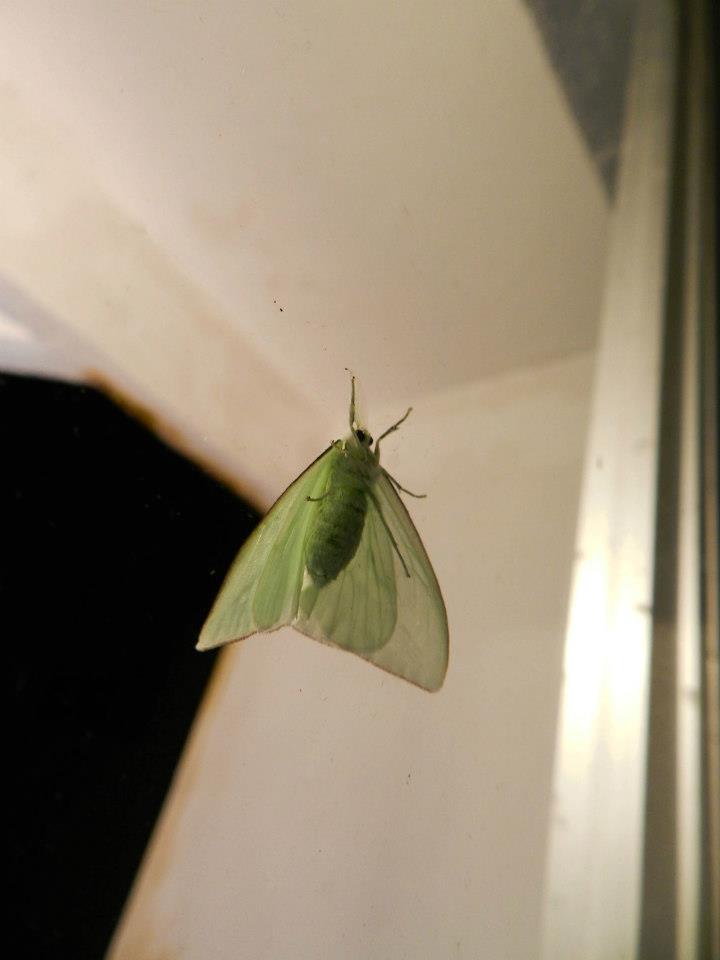
These are some of the moths that were attracted to our light traps. Among all the insects that eventually came to the traps and stayed, I'd have to say that the moths were the most numerous. Most of them were small and brilliantly patterned, although we would eventually come across several sphingiids and saturniids as well. Geometriids were the most common and most of these came in various shades of yellow or green, many similarly patterned with geometrical map-like markings on both wings. 


We eventually nicknamed this moth "Hellboy" until a more concise definition
can be offered.


Aside from moths, the traps also attracted more than their fair share of cicadas! The large insects are clumsy fliers and, after slamming unceremoniously into the light bulbs and walls repeatedly, they would often crash onto the ground where they remained, seemingly in a state of stupor. They were so stunned by this I could even pick them up and place them side by side on my outstretched palm with little or no effect. 


Cicadas came in all shapes and sizes that night! We counted no less than 6 different species that were attracted to the traps. 


There were also an astounding diversity of beetles at our traps. Of all the insects, these were perhaps the worst! Beetles are clumsy fliers at best and when in a state of fright, have sharp claws that they can use to devastating effect. I had many bad experiences with beetles that fell down my color and proceeded to dig their claws into any portion of my skin they happened to come into contact with that the time! I shall take note to wear tighter fitting clothes when I try this again in the future! Most of the beetles weren't particularly remarkable, but we did find several of the long horn (Cerambycidae) and rhinoceros (Dynastidae) variety. Some of these, I ended up keeping, for virtue of their unique appearances! Second note to self: long horn beetles have fearsome jaws and can deliver quite a bite!!! 

The largest cerambycidae that was attracted to our traps that night. It measured several inches from head to tip of abdomen and eventually managed to bite hard enough to crack the flimsy plastic lid of the container.
Of all the other insects that were attracted, most were aletes, the winged generation of various ants and termite species whose identification simply goes beyond my capabilities. There was also a stick insect that somehow found its way there, and a rather opportunistic praying mantis. There really are a lot more pictures to go through, and I will upload them in the second part of this blog post when our photographer, Miss Joanne Tong, has sorted them out from her camera. Until then, Happy Monday.


Cheers, 

Cyren.

Tuesday, April 9, 2013

Keep Calm, they're only 17 year Cicadas!


Hey ya'll!!! 

I woke up this morning with the following item on my news feed "Largest Brood of 17 Year Cicadas to be expected in Spring!" it was shared by a friend and I instantly thought to myself WOW! What a magnificent sight they must be to behold! Evidently, though, the same opinion was not shared by said Facebook friend who included (along with her post) a status update lamenting that "it must be the end of the world!!!" My response to her was typically the same one I came across on this amazing website cicadamania.com :


Cicada nymph! Aren't they cute???
The 17 year cicada is not a locust (as they are sometimes confused for) but an insect belonging to the order of hemiptera, or "true bugs". They are of the genus "magicicada" which was named not because the insects are necessarily "magical" in any way, but because they seemed to miraculously appear out of thin air "just like magic" only once every 13- 17 years. In reality though, the sudden "disappearance" of cicadas for such a long period of time after the 4-6 weeks they are active may be attributed to the insect's prolonged developmental phase. Cicada nymphs (which essentially look like smaller versions of adult cicadas but without wings) live their entire lives under ground where they feed on the sap generated by the roots of large trees. 


transformation of the cicada
from mature nymph to
adult.
The nymphs must go through a process of incomplete metamorphosis whereby they undergo 5 molts (or instars) before they graduate as adult cicadas and the process can take anywhere between 13-17 years which accounts for the "sudden" disappearance of the insects for such a long period of time.  When they do emerge, however, they often do so simultaneously and in very large numbers! This is thought of to be some form of survival strategy known as predator satiation. Cicadas emerge in the thousands, sometimes even in the millions, which makes it impossible for any predator to completely kill them off! This means that there will be plenty of cicadas leftover to mate and lay eggs, thus ensuring the survival of the species. This phenomenon is unlike that of the locust swarm because while the locust swarm is literally a band of insects that move, breed, and feed as a large group, the cicada swarm is really just  a means to an end: ensuring enough adults survive long enough to pass on their genes to the next batch of insects. Indeed, such is the life cycle of most cicada species though the 17 year cicada is the only one to do so in such record numbers.

Other interesting facts about the 17 year cicada 
  • The 17 year Cicada is also known as the periodical cicada. This is because of their survival strategy of emerging in large swarms over the span of a certain period, as opposed to every year. 
  • There are a grand total of 7 species that make up the genus magicicada and 4 of these emerge on a 13 year basis. 
  • The 17 year cicada is perhaps most known for its ability to generate a loud, sometimes deafening sound (as is the case with all cicadas). Male cicadas do this to attract mates and do so by popping a set of muscles on their abdomen known as "tymbals", in and out rapidly.
  • Unlike locusts, cicadas do not defoliate entire plants. Adult cicadas possess piercing mouth parts that they use to suck the sweet sap from trees. Slender trees may be damaged by this process, but large stronger trees do fine. 
  • Last, but not least (this one is my favorite!) 17 year cicadas are affected by the massosporan fungus. An infection that is the equivalent of Cicada STD as it is spread through mating and causes the abdomen of adult cicadas to fall off! (Yikes!!!!)
You can read of such facts, and more at www.cicadamania.com

In conclusion, though the sights and sounds of an insect swarm of such gargantuan proportions can seem like a daunting, even intimidating prospect, when all is said and done... they only come once every 13-17 years! And aside from the loud sounds and the occasional clumsy cicada smack to the face: these insects are really quite harmless which totally begs the question: why can't we all just get along? 

Cheers,
Cyren