Showing posts with label Insects. Show all posts

Monday, May 27, 2013

Memoirs of a Light Trapper - Miniature Monsters pt. 2


Hey ya'll 

It's been quite a while since my last update and the reason for that is that I have been quite busy with sorting out the logistics of my field study at Gopeng Hill, Malaysia. The field study, which will commence next year, is part of the research requirement for my dissertation as a Doctor of Philosophy candidate and will consist of an 8 month stay with the Semai Orang Asli in smaller periods of 2 months at a time in 2014. There, I hope to be able to witness the initiative and participation of the Semai in conservation of biodiversity through their involvement in ecotourism. But more on that later. For now I would like to upload the rest of the pictures from our light trapping expedition last month. Our photographer, Miss Joanne Tong has had her hands full with work from her other expeditions and I am very grateful to her for having been able to assist us in documenting some of the magnificent finds from our trip. Photographing insects proved to be something of a challenge to her, as she had never before participated in a light trapping experiment of this scale but to see her sitting out doors in front of our light traps, a jumble of beetles, moths, and cicadas fluttering about her hair was to see the mark of a photographer, dedicated to capturing the perfect image of her subjects! And boy did these images turn out wonderfully. She even remarked, jokingly, that up close many of the insects she photographed reminded her of of very tiny (albeit cuter versions of) monsters. 


I haven't really had the time to go about identifying each and every one of them, but I have posted the photographs on facebook where they may be identified by some more experienced lepidopterist friends of mine and you can bet that I will be back to update on this post as and when the species and genera come to me! In the meantime, I hope everyone has had an eventful and fruitful year thus far! Just a few more days before June comes along and we'd be halfway into 2013!!! Isn't it funny how fast time flies? And on that note, I shall leave you with a picture of my trap setup and the little insects that were attracted to it.

 
Cheers,
Cyren

Tuesday, April 23, 2013

Top 5 Insect Super Powers

Hey ya'll

In the first part of "Super Powered Insects", I talked about comic books characters that were inspired by the wonders of the entomological world! In the real world, however, many insects are similarly known to possess unique and amazing super-power like abilities! The following are a list of the top 5 insect super powers that I could come up with. 

1. Super Strength! 

A staple in any superhero comic universe: what would DC comics be without Superman, Marvel without The Incredible Hulk, and the natural world without... the industrious ant? Ants are one of the strongest creatures in the animal kingdom, capable of lifting several times their own body weight!!! The actual degree of super-strength varies between ant species, but on average an individual ant can lift anywhere between 10 - 50 times its total body weight. They can even do this upside down, while clinging on seemingly smooth glass-like surfaces! That's pretty amazing. Now it may seem surprising that such a small animal is capable of such feats of strength but the reason behind it all boils down to good old fashion physics and the concept of scaling. Because of their relatively small sizes, ants do not have much body mass. In comparison with this body mass, however, a large proportion of the ant's body is made up of small insect-muscles. Proportionately speaking this gives them the ability to lift and manipulate objects that are much larger and many times heavier than their own body weight. And its not just ants, but insects in general! Honey bees, for instance, have been observed to be able to lift up to 80 percent of their body weight in FLIGHT! More, when they're on the ground. It is not an absolute rule but a general one that the bigger the animals get (and the larger their body mass is) their ability to lift objects of equal to, or heavier than their own weight greatly decreases. Take elephants for example. Elephants can lift up to many tons but did you know they are quite incapable of lifting their own body weight? I guess this is one of those instances where small size, works to their advantage. 

2. Flight

Another fairly common staple power in comic books, flight is an ability most adult insects possess. These guys were virtually the first living things in the world to evolve the ability and subsequently, may be said to be one of the most accomplished as well. Of all the fliers of the insect world, however, it is arguable that none are perhaps as accomplished as the dragonfly! Dragonflies have been around for millions of years, and aside from a drastic decrease in size, have not seemed to have changed very much from their prehistoric ancestors. Consequently, they've also had ample time to perfect their flying skills making them quite literally, the masters of the air. Most dragonflies flap their wings at only 30 beats per second (this is very slow, in comparison to most insects like bees who flap their wings at about 300 times a second) but are still able to complete aerial feats of stunning magnitude! They are accomplished fliers, reaching speeds of up to 58 kilometers per hour (that's about 36 miles) and are more than capable of making sharp turns, sudden dives, and even flying backwards! The reason dragonflies can do this is because of their unique anatomy that enable them to use all four of their wings independently. When used in conjunction with their excellent vision, the dragonfly's mastery of flight makes it an excellent and accurate predator, capable of snatching insects up in mid-flight. 

3. Webbing

Bound 
Okay, so this is not exactly your typical super power! But what would this post be without a reference to spider man! Spider silk is one of the strongest organic substances known to man! The drag like silk of many spider webs (designed to stop flying insects in mid-flight) has often been equated to having the tensile strength of a high grade allow steel filament of the same diameter (purportedly a proportionately spun silken web would even have the strength to arrest a commercial airplane in mid-flight). And while spiders are arachnids and so, not insects (no need to get into a twist, I did not forget that fact!) they are not the only animals capable of producing webbing! The larvae of many insects, perhaps most notably those of butterflies and moths, are quite capable of excreting a similarly fibrous substance that is also known as silk. The silk produced by silkworms (bombyx mori) for instance are one of the strongest natural fibers known to man! In fact, silk garments dating back to 1782 was discovered in relatively durable condition in a wreck expedition in 1840! Silk. is also naturally resistant to most mineral acids. 

4. Radioresistance

Man destroys man. Insects inherit the earth.
I am sure that most of us are no stranger to the urban legend that cockroaches are the only animals capable of surviving a nuclear blast. Now, while it might more accurately be said that cockroaches are capable of surviving the aftermath of the blast (the actual blast would probably kill any roach caught in its vicinity by sheer explosive force a lone), I've got even better news for you: same goes to all insects! Now, I am no expert on radiation, but from what I have read up on the subject, this has something to do with the differing nature of vertebrate and invertebrate cells. Radiation is DEADLY to vertebrate animals and this is because our cells are constantly multiplying. Old cells die every second and are replaced by new cells through the process of mitosis (or something). Radiation affects these growing cells by causing them to act and multiply in ways that are different to their original function which would then eventually lead to mutation (the kind that gives people cancer. Not superpowers). Invertebrate cells, however, only multiply rapidly at specific times of the year. Typically, when they are about to undergo the process of molting. This means that of all the insects who survive the initial nuclear blast, those that are not close to the process of molting would be able to withstand the effects of radiation. In fact, some of these insects may be exposed so long, that their bodies begin to adapt to be genetically radioresistant. This positive trait is then passed on to future generations of insects born in the environment creating a strain of radioresistant insects! And this is no longer the stuff of science fiction or urban legend! Naturally radioresistan insects, worms, and plants have already been discovered in places like Minas Gerais, Brazil, that possess naturally high levels of radiation. 

5. Mind Control 

Take me to your leader! 
I saved the best for last. Mind control is often associated with super villains in the comic book genre. Even when heroes actually possess the capacity for it, they use it only sparingly. There is something entirely sinister about invading the thought processes of another creature and bending it against its will. It is therefore with no surprise that this category goes to the super villains of the insect world: the parasitic wasps. Parasitic wasps are quite literally the nightmares of the insect world. Imagine the worst fear you've ever experienced in your life and now multiple it by a hundred. If insects were capable of complex emotional thought, that would be the kind of year you would feel if you were a helpless larvae facing down the nightmarish gaze of a parasitic wasp. Like elegant but deadly assassins, the wasps employ a wide range of methods to subdue, and coerce their prey. The female of the jewel wasp (Ampulex compressa) for instance, preys on the common cockroach. She delivers two stings, both targeted at the roach's ganglion (that's the insect equivalent of a central nervous system). First, she does this to paralyze the front legs of her prey thus reducing mobility and inhibiting resistance. Next, she delivers a second sting at the direct spot of the roach's brain. This causes an immediate behavioral change in the roach. It becomes docile, it becomes compliant, and it will now follow the wasp willingly (as if being led on a leash) to her nest ,where she will proceed to deposit a single egg upon the roach's abdomen. When the egg hatches the larvae will feed on it, eventually living inside of it as an endoparasite. The larvae feeds only on the non-essential organs of the roach thus keeping the host alive until it is matured and ready to emerge as a fully grown wasp. Throughout the entire process, the roach is motionless. It is alive, but does not attempt to escape, seemingly content to rest in the burrow allowing the larvae to eat it alive. For all intents and purposes, the wasp's sting has turned it into a zombie. In another species of wasp, the larvae becomes a parasite of large spiders and upon maturity, will alter the spider's behavior to use its dying strength to spin a silken cocoon to protect the larva during its final stage of development. Talk about creepy. 

So that's it for my list of the top 5 insect super powers! Know any others I might have missed out, or wish to request something be added to the list? Send me a shout on any of my social networking pages (twitter, facebook, email) or leave a note in the comments below! 

Cheers,
Cyren. 

Wednesday, April 17, 2013

Bug Biters

Hey ya'll

Just a random post in the middle of the week! Comic Fans, Anime Geeks, Otakus and Poke'mon Nerds will probably appreciate this!


These guys were all on my team!!! 

Have a great middle-of-the-week everyone!
Cheers,
Cyren. 

Sunday, April 14, 2013

Memoirs of a Light-Trapper: expeditions and experiments in light-trapping pt. 1


Hey ya'll

Chasing after butterflies and other flying insects with a net can be great fun during the day, but catching nocturnal insects is a totally different ball game altogether. It is, after all, not very practical for one to go traipsing about in the forests in pitch darkness while waving a net blindly around in hopes of accidentally catching something that flies by! As such many entomologists and lepidopterists have developed, over the years, a variety of techniques and methods that are quite reliable at attracting insects for the purposes of study or collection. The most efficient of all these, is probably light trapping. Light trapping is basically a method of attracting insects that involves the use of a light source (usually a mercury vapor bulb, or some other source that emits UV light). The light is often dispersed through the use of a white cloth (that can greatly increase the light's surface area) and functions as a veritable beacon that attracts moths, beetles, and any large number of flying insects to its surface. Think of a bug zapper, but on a larger scale. And minus the deadly electricity. Insects attached to the white cloth may then be studied in closer detail, photographed, or collected depending on its purpose.


Recently, I've had the opportunity of conducting one such expedition which took place in the form of a mini experiment. Two light traps were set with different bulbs, one emitting a specturm of UVA (orange/warm light), the other of UVB (white light). Through the course of the night we discovered that different insects were attracted to different spectrum of light. While the UVA bulb seemed to attract more insects on the initial stage, many of them eventually shifted their focus over to the UVB bulb where they proceeded to swarm and seethe in a writhing mass of antennae, legs, and wings. The diversity of insects which arrived was also, to say the least, quite astounding and we had (in addition to moths of just about every shape, size, and color) some very attractive looking beetles and cicadas. Below are some of the amazing insects that were attracted to our light traps that night.

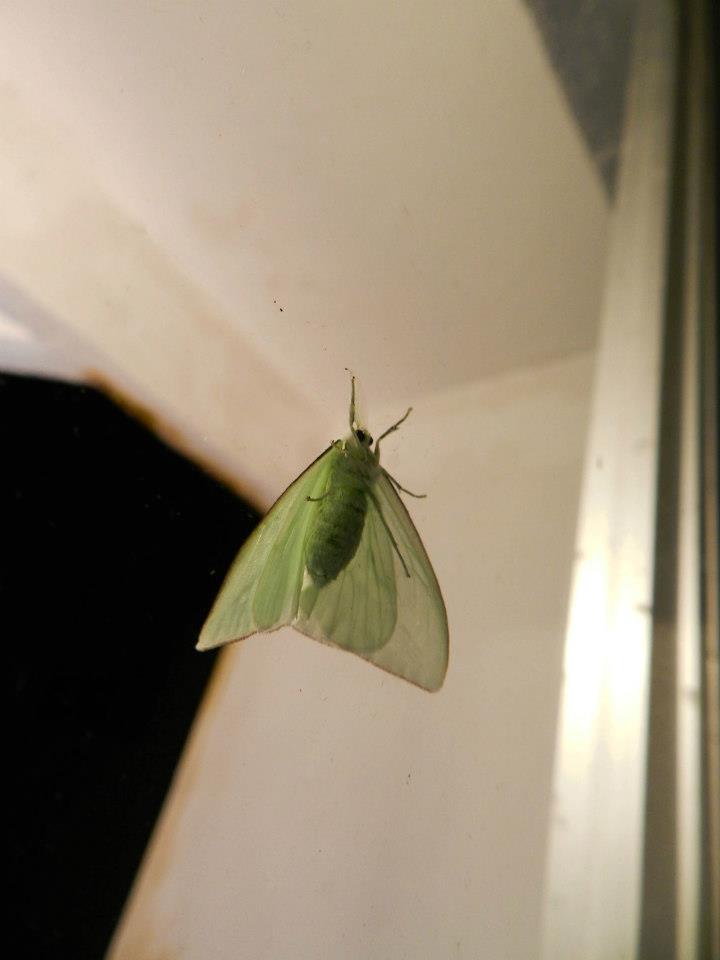
These are some of the moths that were attracted to our light traps. Among all the insects that eventually came to the traps and stayed, I'd have to say that the moths were the most numerous. Most of them were small and brilliantly patterned, although we would eventually come across several sphingiids and saturniids as well. Geometriids were the most common and most of these came in various shades of yellow or green, many similarly patterned with geometrical map-like markings on both wings. 


We eventually nicknamed this moth "Hellboy" until a more concise definition
can be offered.


Aside from moths, the traps also attracted more than their fair share of cicadas! The large insects are clumsy fliers and, after slamming unceremoniously into the light bulbs and walls repeatedly, they would often crash onto the ground where they remained, seemingly in a state of stupor. They were so stunned by this I could even pick them up and place them side by side on my outstretched palm with little or no effect. 


Cicadas came in all shapes and sizes that night! We counted no less than 6 different species that were attracted to the traps. 


There were also an astounding diversity of beetles at our traps. Of all the insects, these were perhaps the worst! Beetles are clumsy fliers at best and when in a state of fright, have sharp claws that they can use to devastating effect. I had many bad experiences with beetles that fell down my color and proceeded to dig their claws into any portion of my skin they happened to come into contact with that the time! I shall take note to wear tighter fitting clothes when I try this again in the future! Most of the beetles weren't particularly remarkable, but we did find several of the long horn (Cerambycidae) and rhinoceros (Dynastidae) variety. Some of these, I ended up keeping, for virtue of their unique appearances! Second note to self: long horn beetles have fearsome jaws and can deliver quite a bite!!! 

The largest cerambycidae that was attracted to our traps that night. It measured several inches from head to tip of abdomen and eventually managed to bite hard enough to crack the flimsy plastic lid of the container.
Of all the other insects that were attracted, most were aletes, the winged generation of various ants and termite species whose identification simply goes beyond my capabilities. There was also a stick insect that somehow found its way there, and a rather opportunistic praying mantis. There really are a lot more pictures to go through, and I will upload them in the second part of this blog post when our photographer, Miss Joanne Tong, has sorted them out from her camera. Until then, Happy Monday.


Cheers, 

Cyren.

Butterfly display case


Hey ya'll 

Just a quick updates before Monday. Display cases an be so difficult and near impossible to locate in Malaysia and so,  I finally decided to invest some time and money into constructing my very own butterfly and moth display case! It wasn't easy, and it cost me a lot of painful fingers, and quite a bit of money... but I daresay the result is well worth it! Anyway I have more buggy delights coming up in the next few weeks or so, so please stay tuned. Somewhat inspired by the success of this display, I'm thinking of constructing another one detailing the life history of various Malaysian cicadas! Stay tuned. 


Cheers,
Cyren.

Tuesday, April 9, 2013

Keep Calm, they're only 17 year Cicadas!


Hey ya'll!!! 

I woke up this morning with the following item on my news feed "Largest Brood of 17 Year Cicadas to be expected in Spring!" it was shared by a friend and I instantly thought to myself WOW! What a magnificent sight they must be to behold! Evidently, though, the same opinion was not shared by said Facebook friend who included (along with her post) a status update lamenting that "it must be the end of the world!!!" My response to her was typically the same one I came across on this amazing website cicadamania.com :


Cicada nymph! Aren't they cute???
The 17 year cicada is not a locust (as they are sometimes confused for) but an insect belonging to the order of hemiptera, or "true bugs". They are of the genus "magicicada" which was named not because the insects are necessarily "magical" in any way, but because they seemed to miraculously appear out of thin air "just like magic" only once every 13- 17 years. In reality though, the sudden "disappearance" of cicadas for such a long period of time after the 4-6 weeks they are active may be attributed to the insect's prolonged developmental phase. Cicada nymphs (which essentially look like smaller versions of adult cicadas but without wings) live their entire lives under ground where they feed on the sap generated by the roots of large trees. 


transformation of the cicada
from mature nymph to
adult.
The nymphs must go through a process of incomplete metamorphosis whereby they undergo 5 molts (or instars) before they graduate as adult cicadas and the process can take anywhere between 13-17 years which accounts for the "sudden" disappearance of the insects for such a long period of time.  When they do emerge, however, they often do so simultaneously and in very large numbers! This is thought of to be some form of survival strategy known as predator satiation. Cicadas emerge in the thousands, sometimes even in the millions, which makes it impossible for any predator to completely kill them off! This means that there will be plenty of cicadas leftover to mate and lay eggs, thus ensuring the survival of the species. This phenomenon is unlike that of the locust swarm because while the locust swarm is literally a band of insects that move, breed, and feed as a large group, the cicada swarm is really just  a means to an end: ensuring enough adults survive long enough to pass on their genes to the next batch of insects. Indeed, such is the life cycle of most cicada species though the 17 year cicada is the only one to do so in such record numbers.

Other interesting facts about the 17 year cicada 
  • The 17 year Cicada is also known as the periodical cicada. This is because of their survival strategy of emerging in large swarms over the span of a certain period, as opposed to every year. 
  • There are a grand total of 7 species that make up the genus magicicada and 4 of these emerge on a 13 year basis. 
  • The 17 year cicada is perhaps most known for its ability to generate a loud, sometimes deafening sound (as is the case with all cicadas). Male cicadas do this to attract mates and do so by popping a set of muscles on their abdomen known as "tymbals", in and out rapidly.
  • Unlike locusts, cicadas do not defoliate entire plants. Adult cicadas possess piercing mouth parts that they use to suck the sweet sap from trees. Slender trees may be damaged by this process, but large stronger trees do fine. 
  • Last, but not least (this one is my favorite!) 17 year cicadas are affected by the massosporan fungus. An infection that is the equivalent of Cicada STD as it is spread through mating and causes the abdomen of adult cicadas to fall off! (Yikes!!!!)
You can read of such facts, and more at www.cicadamania.com

In conclusion, though the sights and sounds of an insect swarm of such gargantuan proportions can seem like a daunting, even intimidating prospect, when all is said and done... they only come once every 13-17 years! And aside from the loud sounds and the occasional clumsy cicada smack to the face: these insects are really quite harmless which totally begs the question: why can't we all just get along? 

Cheers,
Cyren

Sunday, April 7, 2013

Bug-on-Bug Violence: Wing Diversity and the evolutionary Arm's race


Hey ya'll!

Weaver ants brutalizing a caterpillar
It's a bug eat bug world, and in the insect kingdom, everything is almost certainly food for something else, as I was explicitly reminded on my way home from dinner! Pictured here are an army of red weaver ants (Oecophylla sp.) brutalizing an unidentified caterpillar. Now caterpillars are essentially the sitting ducks of the insect world. They're soft, and vulnerable, and they can't even move very quickly! Consequently, many of them have developed a variety of strategies and means through which they can defend themselves from predators (to read more about the amazing ways they do this, click here). 

Ants targeting the weak spots of a spined caterpillar
Nature, however, always finds a way and many predators have eventually learnt how to bypass the natural defenses of these animals. Take this case, for example: The caterpillar in mention is what I believe to be the larvae of the Tawny coster (acraea terpsicore/violae), a brightly colored butterfly with leathery wings and a lazy flight. Under normal circumstances, the caterpillars of these butterflies are rather bold insects. They possess a unique chemical defense system, sequestered from the mildly poisonous leaves of the passiflora vines on which they feed on, that make them severely distasteful to birds and most vertebrate predators. Invertebrate predators, on the other hand, aren't so choosy about taste and so to protect themselves from such animals, the caterpillars have evolved a series of sharp and rigid spines that adorn the length of their entire bodies. These spines are not poisonous and do not break easily and it is speculated that what they do, is create (quite literally!) and arm's length of space between any potential predator and the caterpillar's vulnerable body.

When attacking armored prey, like beetles, many ants have
learnt to target the joints, the weak spots in the larger
insect's armor. Here they can inject their poison to
eventually overcome their prey.
These ants in question, however, seemed to have figured out a way to bypass all of that. By literally clipping off the spines bit by bit, the same way a gardener might trim the hedge, the ants whittle away at the caterpillar's defenses until they are able to expose the soft, succulent flesh beneath. And this is not something new. Similar behavior have been observed in the infamous Army ants (Eciton sp.) of Southern America. In fact, many of ants have even taken things one step further and are similarly known to exploit the weak points in the armor of armored invertebrates such as beetles and scorpions. Though the process can take up quite a significant bit of time and energy, the ants will often persevere until the defenses of the prey are completely whittled away. Protein can be very rare and is subsequently a very valuable natural resource in the insect world. Any amount of it (however small) is clearly worth every bit of effort!

The brightly colored, and patterned wings of many
butterflies are thought to function as biological
billboards that provide various signals to other butterflies
as well as animals of other species.
And so it has always been, the evolutionary arms race that began when the first invertebrate crawled out of the ocean, and so it continues to this very day. The need to feed and breed, coupled with the drive to escaped predation has resulted in the diversity and magnificence of insects we have come to know of today. Every insect's uniqueness, every part of it that stands out (aside from the basic anatomy) evolved, often for specific purposes that would aid its survival as an individual and as a species. Take the structure of insect wings for example. The wings of insects are probably one of the most diverse flight structures in the natural world as we know it and are believed to have their origin in gill-like structures possessed by some primitive invertebrates. When mosses and plants began to creep out of the ocean to colonize the shores, invertebrates were soon to follow. Not all of them, however, lost these gill like structures and many continued to retain these flap-like projections as a form of vestigial growth.


The frontal pair of a beetle's wings have evolved into
a virtually impenetrable,waterproof armor known as an
elytra and protects the more fragile set of flight wings
as well as the beetle's body from attack.
But as more invertebrates continued to move to land and evolved into insects, their predators were also quick to follow. It eventually became imperative once again, that insects evolved new strategies to ensure their survival and that of their species. Climbing, the unique ability of insects to scale most vertical surfaces, was believed to have evolved as such a strategy. But the most amazing of all, is perhaps the evolution of the insect wing. The flap-like projections that some insects retained as vestigial growths now developed a new purpose: it gave them the ability to glide! Gliding became an invaluable means of escape as, aside from the insects who retained this ability, there were NO flying predators at the time. This, more than anything else, led to the streamlining of the gliding process and the correspondent anatomical part to give rise to the very first insect wing making the insect quite literally, the first animal capable of sustained flight! The continued benefit of flight propelled the continued evolution of the wing resulting in the sophistication and diversity of wing design witnessed in insects today.
Some pictures of other insect wings, to give you a better idea.
Dragonfly wings have evolved to be strong and resilient structures. They are
waterproof and can function with great dexterity and independence of each other
allowing the dragonfly to be one of the most accomplished of aerial predators.
Cicada wings
Grasshopper wings
Leafhopper wings
But of course, the evolutionary arms race in insects is not limited to its wings. In fact, every part of an insect's anatomy was originally geared towards helping the species survive each other. The barbed stings of bees for instance, was thought to have evolved as a defense mechanism against invertebrate predators. Interestingly enough, bees do not die when they sting invertebrate such as hornets and moths, which frequently invade their hives. The eventual introduction of vertebrate predators into the mix only branched this evolution out further. The following illustrated chart might give you an idea as to how this might have taken place.  


This, combined with the fact that insects have been around far longer than any other living creature on the planet, and because of their fast reproduction rates, has lead insects to diversify to the point that they are quite literally one of the most successful animals on the planet! Try to remember that the next time you witness an ant carving up a caterpillar, or stop to appreciate the remarkable patterns on the wings of a butterfly. You might very well be witnessing the result and progress of the evolutionary arms race!

Cheers,
Cyren