Hey ya'll
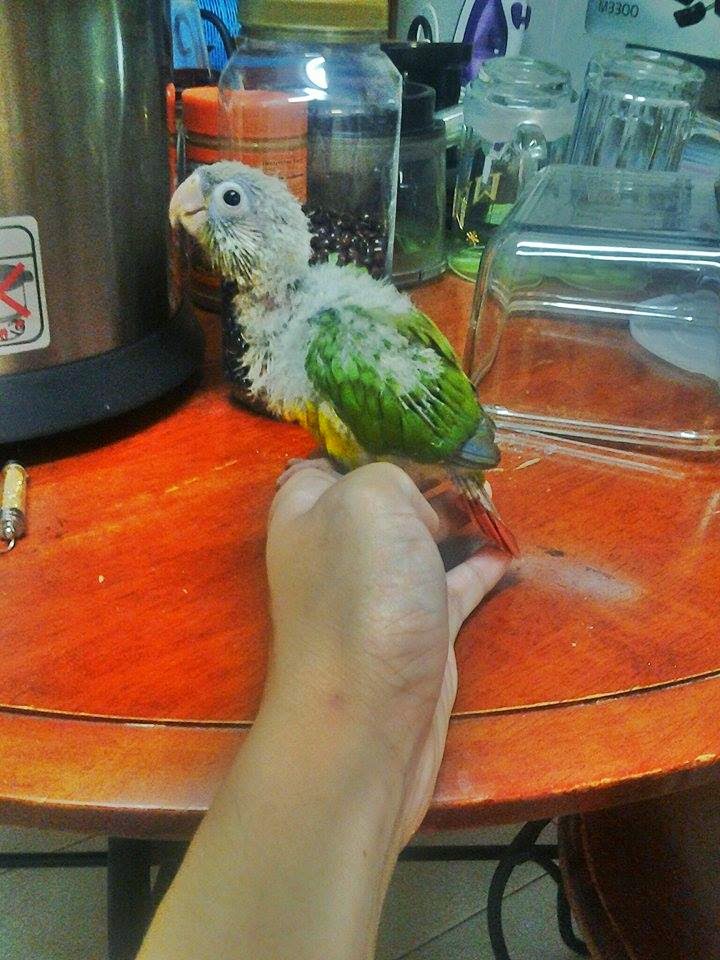
I recently came into possession of a very young parakeet that is probably between 3 weeks to a month old. It is a very fragile looking thing, still mostly covered in fluffy grey down with pin feathers erupting from its flesh here and there, but with a very scrappy and robust personality. Having spent almost a full year with the Semai people of Peninsular Malaysia (you can read more about that
here) I've managed to learn a trick or two about hand raising young birds, often for rehabilitation purposes, out of necessity while living in the jungle. Most of the birds that I had successfully raised and released into the wild, however, were of the Starling (sturnidae) and old world fly-catcher (muscicapidae) family respectively. Only once was I forced to raise a young parrot and in all honesty the abandoned bird was already old enough to eat mashed up bananas and other soft foods from the tip of my finger. Nevertheless, those experiences, and the knowledge that came with it, made me believe that I was more than capable of handling a young parrot as well. After all, a baby bird is a baby bird, how different could it be? Barely 3 days into my raising this bird I can say that arguably, there IS not much difference between the hand rearing of parrots and other bird species. The general care is pretty much the same with regards to temperature and cleanliness with the chief (and most challenging) difference being triggering the appropriate feeding responses from the hatchlings.
 |
| Our latest baby! We aren't able to sex it because GCs do not display sexual dimorphism but based on a hunch we have decided to name "him" Yoshi. |
Parrots, you see, possess a special organ at the base of their throat known as a crop. The crop is a pouch like bulge that can expand for the bird to store its food for digestive purposes. Birds like starlings and fly catchers do not possess crops (or at least I don't think they do) and so when they beg for food often raise their heads skywards, with their mouths open wide, thus facilitating the passage of food from beak to gut. Baby parrots, however, receive their meals in a more direct manner with the parent bird often regurgitating half-digested food into the baby's throat. The passage of food from mouth to gut must first bypass the crop and to ensure that the food is stored within it, the baby parrot assists the motor reflexes of its esophagus by making a vigorous pumping motion with its head. Feeding is therefore not quite as simple as placing a syringe into the chick's gaping maw and pumping its contents straight down the throat. The shape of the parrot's bill (which is hooked) makes it also somewhat difficult as they do not beg in quite the same way as other birds. I gradually learnt that unless I took a more direct approach to it, feeding was always going to be a messy business (messier than it generally is with baby birds, which is to say, fairly messy!). By gently holding it from behind I was able to support Yoshi's head with my thumb and index finger and thus able to keep pumping in the formula with my other hand all the while adjusting to the pumping motion of his head.
 |
| The baby parrot is also a very inquisitive little fellow and often gets distracted easily by other animals, or by objects lying around at the time of its feeding such as cardboard rolls or pieces of tissue paper. I usually stop between feedings if Yoshi goes off to explore something as I think this helps encourage foraging behavior later in life. |
 |
As might be expected, Yoshi didn't take to being hand-fed by a new "mommy" fron the start but with patience and a lot of coaxing (I "talk" or make soothing noises to my birds as I feed them as I imagine that they are as much vocal as they are visual animals), he has finally started to warm up to me and feedings normally take 30 minutes or less per session, including the little breaks we take in between when he finds a piece of tissue paper or the food bowl to his fancy.
I have been receiving some conflicting information regarding how often I have to feed Yoshi, and how much. With my starlings and robins, feeding was generally done at 8am each morning and then once at every 2 hour interval with the frequency gradually decreased as the bird grows larger and becomes more and more independent. With Yoshi however, I find that this is where the parrot's crop has an added advantage to function as an indicator of when to start and stop feeding. The breeder I got him from only fed him two times a day, 10 tubes of formula per session, but told me that I could adjust his feeding accordingly as they were busy tending to so many animals during the course of one day. I learnt very quickly on to adjust Yoshi's feeding based on the size of his crop. When he has had a particularly large feeding (10 full tubes of formula, as instructed by the breeder) his crop becomes slightly distended and has the consistency of a squishy grape. Other times, when for whatever reason he may not feel like eating so much, the size of the crop can vary quite significantly. On average it takes Yoshi's crop 4 hours to empty out which is an indicator for me to begin feeding again. Based on the amount of tubes he takes per feeding (averaging between 5 and 8, almost never 10), I spread out his feedings at 3-4 times a day at every 4 hour interval, or whenever his crop has been emptied out. In this way, Yoshi has never had to beg for food and (aside from day 1 when he came home with an empty crop) has never screamed his little lungs out demanding a feeding.
|
 |
| I've also started keeping a record of Yoshi's feedings such as the time daily, as well as how many tubes of formula he consumes every feeding. Right now he has consumed 26 tubes daily (6 more tubes than he was given at his breeder's place) spaced out at 4 hour intervals 3-4 times daily. The size of his crop gives me an indication of when a feeding is required and how much of it. |
I will begin to post updates about Yoshi's growth and development has time goes by. I plan to buy a weighing scale and start measuring his weight on a weekly basis as well. Weaning is something that I anxiously anticipate but I think I should have less difficulty than my starlings and robins, particularly because his naturally curious disposition has already led him to start nibbling at objects in his environment.