Showing posts with label Moths. Show all posts

Monday, May 27, 2013

Memoirs of a Light Trapper - Miniature Monsters pt. 2


Hey ya'll 

It's been quite a while since my last update and the reason for that is that I have been quite busy with sorting out the logistics of my field study at Gopeng Hill, Malaysia. The field study, which will commence next year, is part of the research requirement for my dissertation as a Doctor of Philosophy candidate and will consist of an 8 month stay with the Semai Orang Asli in smaller periods of 2 months at a time in 2014. There, I hope to be able to witness the initiative and participation of the Semai in conservation of biodiversity through their involvement in ecotourism. But more on that later. For now I would like to upload the rest of the pictures from our light trapping expedition last month. Our photographer, Miss Joanne Tong has had her hands full with work from her other expeditions and I am very grateful to her for having been able to assist us in documenting some of the magnificent finds from our trip. Photographing insects proved to be something of a challenge to her, as she had never before participated in a light trapping experiment of this scale but to see her sitting out doors in front of our light traps, a jumble of beetles, moths, and cicadas fluttering about her hair was to see the mark of a photographer, dedicated to capturing the perfect image of her subjects! And boy did these images turn out wonderfully. She even remarked, jokingly, that up close many of the insects she photographed reminded her of of very tiny (albeit cuter versions of) monsters. 


I haven't really had the time to go about identifying each and every one of them, but I have posted the photographs on facebook where they may be identified by some more experienced lepidopterist friends of mine and you can bet that I will be back to update on this post as and when the species and genera come to me! In the meantime, I hope everyone has had an eventful and fruitful year thus far! Just a few more days before June comes along and we'd be halfway into 2013!!! Isn't it funny how fast time flies? And on that note, I shall leave you with a picture of my trap setup and the little insects that were attracted to it.

 
Cheers,
Cyren

Sunday, April 14, 2013

Memoirs of a Light-Trapper: expeditions and experiments in light-trapping pt. 1


Hey ya'll

Chasing after butterflies and other flying insects with a net can be great fun during the day, but catching nocturnal insects is a totally different ball game altogether. It is, after all, not very practical for one to go traipsing about in the forests in pitch darkness while waving a net blindly around in hopes of accidentally catching something that flies by! As such many entomologists and lepidopterists have developed, over the years, a variety of techniques and methods that are quite reliable at attracting insects for the purposes of study or collection. The most efficient of all these, is probably light trapping. Light trapping is basically a method of attracting insects that involves the use of a light source (usually a mercury vapor bulb, or some other source that emits UV light). The light is often dispersed through the use of a white cloth (that can greatly increase the light's surface area) and functions as a veritable beacon that attracts moths, beetles, and any large number of flying insects to its surface. Think of a bug zapper, but on a larger scale. And minus the deadly electricity. Insects attached to the white cloth may then be studied in closer detail, photographed, or collected depending on its purpose.


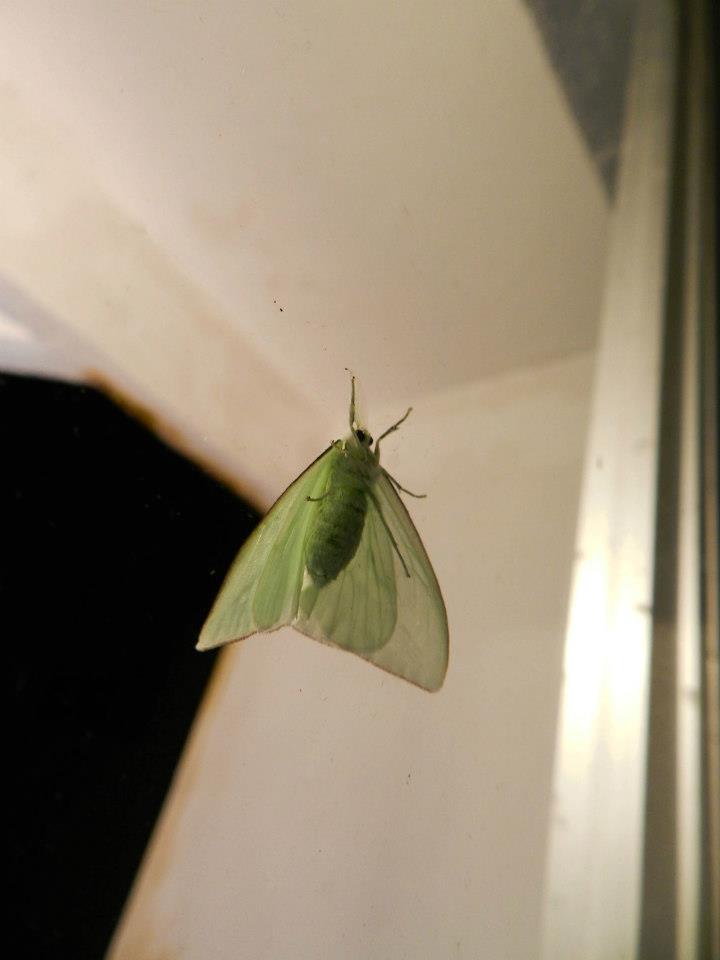
Recently, I've had the opportunity of conducting one such expedition which took place in the form of a mini experiment. Two light traps were set with different bulbs, one emitting a specturm of UVA (orange/warm light), the other of UVB (white light). Through the course of the night we discovered that different insects were attracted to different spectrum of light. While the UVA bulb seemed to attract more insects on the initial stage, many of them eventually shifted their focus over to the UVB bulb where they proceeded to swarm and seethe in a writhing mass of antennae, legs, and wings. The diversity of insects which arrived was also, to say the least, quite astounding and we had (in addition to moths of just about every shape, size, and color) some very attractive looking beetles and cicadas. Below are some of the amazing insects that were attracted to our light traps that night.

These are some of the moths that were attracted to our light traps. Among all the insects that eventually came to the traps and stayed, I'd have to say that the moths were the most numerous. Most of them were small and brilliantly patterned, although we would eventually come across several sphingiids and saturniids as well. Geometriids were the most common and most of these came in various shades of yellow or green, many similarly patterned with geometrical map-like markings on both wings. 


We eventually nicknamed this moth "Hellboy" until a more concise definition
can be offered.


Aside from moths, the traps also attracted more than their fair share of cicadas! The large insects are clumsy fliers and, after slamming unceremoniously into the light bulbs and walls repeatedly, they would often crash onto the ground where they remained, seemingly in a state of stupor. They were so stunned by this I could even pick them up and place them side by side on my outstretched palm with little or no effect. 


Cicadas came in all shapes and sizes that night! We counted no less than 6 different species that were attracted to the traps. 


There were also an astounding diversity of beetles at our traps. Of all the insects, these were perhaps the worst! Beetles are clumsy fliers at best and when in a state of fright, have sharp claws that they can use to devastating effect. I had many bad experiences with beetles that fell down my color and proceeded to dig their claws into any portion of my skin they happened to come into contact with that the time! I shall take note to wear tighter fitting clothes when I try this again in the future! Most of the beetles weren't particularly remarkable, but we did find several of the long horn (Cerambycidae) and rhinoceros (Dynastidae) variety. Some of these, I ended up keeping, for virtue of their unique appearances! Second note to self: long horn beetles have fearsome jaws and can deliver quite a bite!!! 

The largest cerambycidae that was attracted to our traps that night. It measured several inches from head to tip of abdomen and eventually managed to bite hard enough to crack the flimsy plastic lid of the container.
Of all the other insects that were attracted, most were aletes, the winged generation of various ants and termite species whose identification simply goes beyond my capabilities. There was also a stick insect that somehow found its way there, and a rather opportunistic praying mantis. There really are a lot more pictures to go through, and I will upload them in the second part of this blog post when our photographer, Miss Joanne Tong, has sorted them out from her camera. Until then, Happy Monday.


Cheers, 

Cyren.

Saturday, April 6, 2013

Caterpillar Couture: Fashion and Survival in the Insect World


Hey ya'll 

Of all the wonderful butterflies and moths that I have seen in my short (but somewhat eventful) life, the only other insect that can perhaps compare with these winged beauties in terms of sheer wonder and elaboration in evolutionary design, are perhaps their very own offspring: the caterpillars. Now it is quite understandable that most people would find this statement perplexing as it is true that the general rule is for caterpillars to remain as unnoticeable as possible! A caterpillar, generally speaking, is literally nothing more than a skin filled with hydro-static hemolymph and developing organs! Consequently, it is really quite fragile and vulnerable to attack! Staying hidden, or properly camouflaged with one's surroundings, is therefore a pretty necessary strategy that most caterpillars have to learn, or die trying! Some caterpillars, however, have absolutely no need to hide! And while a caterpillar is most certainly not the most aggressive of animals, many of them have developed chemicals means through which they may defend themselves from predators and they often do this in very fashionably beautiful and amusing ways! 

The caterpillar of the puss moth (Cerura vinula) is a fairly unremarkable caterpillar for most of the time. That is, until you piss it off! It really is about as aggressive as a caterpillar can be. When threatened, the caterpillar will rear up on its hind legs to display a striking looking "face" that might startle predators into backing off. To enhance the illusion, the caterpillar also possesses a pair of tentacles or tendrils at the back of its body that it can wave about furiously and menacingly to ward off potential predators. If all else fails, though, the caterpillar will employ its final method of defense: a concentrated spray of formic acid to the face! Formic acid is a type of poison that is typically produced by ants, wasps, and bees, and the caterpillar of the puss moth is quite unique in its ability to do so. 


Not all caterpillars have to be aggressive to ward off predators though, and in fact, aside from the larvae of the Puss moth, few actually are! Most caterpillars employ a more passive aggressive means of defense typically meaning they will remain passive even when a predator is being aggressive. But who needs to be aggressive really, when your entire body is covered in a cornucopia of envenomed spikes that will make even Lady Gaga turn green with envy! Slug moth caterpillars (Limacodidae) are perhaps one of the most interesting caterpillars in the lepidopteran world! The variation in coloring and form is only as diverse as the various means through which they defend themselves. Many though, are covered in some form of urticaria. This means that brushing against one of these caterpillars can be potentially discomforting or even painful! Caterpillars of the tussock moth also advertise themselves brazenly with tufts of fur and setea that look more at place in a Mardi Gras parade than on an insect. The caterpillar, however (surprisingly enough) is not poisonous per-say. Rather these setea break off very easily and may cause a rash if embedded in the mucousa membranes of animals. This sort of defense is believed to target the mouths and eyes of predators as the thickness of the fur, and the extreme ease through which they break off is often enough to protect the insect from the predator's initial strike.  


As "prevention is always better than aggression" seems to be the prevailing policy when it concerns most insects, many of these caterpillars are also brightly colored so that they will not easily be missed such as the caterpillar of the lacewing butterflies  (Cethosia sp.) While one might think that this would attract predators, the bright colourations are typical of aposematic warnings in the animal Kingdom. Basically they advertise: "Attack me, and you might just regret it!" Many animals learn to avoid caterpillars with such coloring and are therefore less likely to attack them even by accident as the bright colors force the predators to take special attention to their presence.


Because the methods of aposematic coloration are so good at warding off predators, this has led to the emergence of several "copy cats" in the animal kingdom. After all, why waste time and energy synthesizing poisons from the plants that you eat when you can just "look" poisonous and be done with it. The hickory horned devil (Citheronia regalis) is a perfect example of this. These caterpillars look extremely BADASS! In fact in terms of appearances, these caterpillars are like the siege tanks of the insect kingdom. The caterpillar is one of the largest in North America and can grow to over 5 inches in length and are crowned with brightly colored, cruel looking spines along their heads and down their backs. The caterpillars themselves, however, are quite harmless and it would seem that evolution is finally catching up to them! Despite their fearsome appearances, more and more of these caterpillars are consumed by birds every year and the numbers are increasing! In fact in some areas they have even been recorded to have become "local bird favorites". Better keep up with the evolution, guys! 

However when all is said and done, perhaps the best defense IS still a best defense and why expend any energy at all synthesizing poisons, drawing attention to oneself, or pretending to be something one is not when one can simply just blend into one's surroundings? Some caterpillars, however, take "blending in" to new extremes. The caterpillars of the jewel moths (Acraga sp.) are named not for their adult form (which resemble furry dog-moth hybrids) but rather, their larval stages which literally resemble translucent/transparent mounds of gelatinous flesh! These caterpillars theoretically remain entirely invisible by refracting and reflecting the colors and lights from their surroundings making them, quite literally, mother nature's cloaking device! Perhaps the "prettiest" way of remaining unseen. 

Cheers,
Cyren

Tuesday, April 2, 2013

Butterflies and Moths collections update

Hey ya'll

I couldn't help myself. I did it! I know I was planning to wait until I had a proper display case before I removed the butterflies and moths from the spreading boards, but I just couldn't help myself. The anticipation was killing me and since I had extra tupperwares lying around I thought to myself "why not?!" Anyway here they are! Most of these lepidoptera are Malaysian but there are a few exceptions that come from mainly Europe, Africa and South America. Mind you, these insects were donated most generously for my collection by Mr Khalid Fadil, who is perhaps one of the more knowledgeable butterfly-moth persons in the country. Meanwhile, I hope you enjoy the compilation as much as I did.


Correction: This is really Eupterote naumanni

Craetonotus gangis

Eacles imperialis


Delias caenus

Delias ligata


Cheers,
Cyren